A modern fast-food restaurant needs more than a cash register. It needs technology that can process orders quickly, connect the kitchen and front counter, manage digital orders, support drive-thru operations, and provide accurate sales data. These capabilities are especially important when choosing quick-service POS software for a high-volume restaurant.
That is why the Burger King POS system is an important part of the brand’s restaurant technology infrastructure.
Burger King has been modernizing its technology stack, particularly in North America. In 2023, Burger King selected PAR Technology as its exclusive POS software and services provider for traditional restaurants across North America, with PAR’s Brink POS and MENU Link solutions forming a major part of the technology platform.
But what exactly does the system do, and why is it suitable for a high-volume quick-service restaurant?
What POS System Does Burger King Use?
For traditional Burger King restaurants in North America, the primary POS platform is PAR Brink POS.
Burger King selected PAR Technology to provide Brink POS and related marketplace order-management technology across its North American traditional restaurant locations. The platform is designed for omnichannel ordering, kitchen management, restaurant operations, and analytics.
However, it is important not to assume that every Burger King restaurant worldwide uses the same software. Different markets, franchisees, and legacy technology environments can use different systems.
For example, Oracle documentation highlights Burger King franchise operations using Oracle Simphony, while older franchise technology has also included systems from providers such as MICROS and PAR.
So, when discussing the Burger King restaurant POS system, the most accurate answer is that technology can vary by market, but PAR Brink is the key POS platform selected for Burger King’s traditional North American restaurants.
What Is the Burger King POS System?
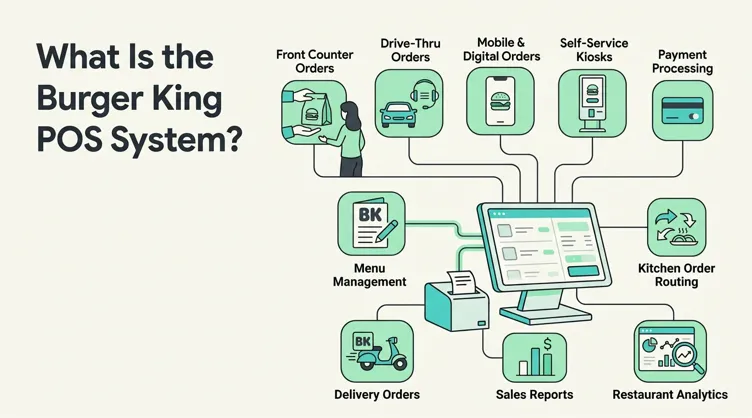
A point of sale system is the technology used to enter, process, route, and record restaurant transactions. To understand how these capabilities have evolved beyond traditional checkout systems, see what a modern point-of-sale system offers.
In a quick-service restaurant such as Burger King, a POS system can connect several parts of the operation, including:
- Front-counter ordering
- Drive-off-sale orders
- Kitchen order routing
- Payment processing
- Digital and mobile orders
- Delivery orders
- Self-service kiosks
- Menu management
- Sales reporting
- Restaurant analytics
Burger King’s franchise requirements have historically specified an integrated electronic POS system capable of recording sales, supporting POS operations, routing orders, capturing ticket data, and supporting product ordering.
This shows why a large restaurant chain needs considerably more than basic checkout software.
Key Features of Burger King POS Software

1. Fast Order Processing
Speed is critical in quick-service restaurants.
The POS interface allows employees to enter customer orders and send the relevant information to the appropriate operational areas. A streamlined interface can reduce unnecessary steps and help employees process more customers during busy periods.
For a brand serving high volumes of customers, even small improvements in order-entry speed can have a meaningful operational impact.
2. Omnichannel Ordering
Customers no longer order only at the counter.
A modern Burger King ordering system needs to support multiple ordering channels, including:
- Restaurant counter orders
- Drive-thru
- Mobile ordering
- Online ordering
- Self-service kiosks
- Third-party delivery marketplaces
PAR’s MENU Link technology is designed to consolidate marketplace orders and connect external ordering channels with restaurant operations. This kind of connectivity is similar to how businesses use POS integration with their websites to keep online and in-store operations connected.
This reduces the need for employees to manually manage orders across multiple disconnected systems.
3. Drive-Thru Integration
Drive-thru speed is one of the most important operational metrics for a quick-service restaurant.
A restaurant POS can connect the customer’s order with the kitchen and payment process, helping employees move orders through the operation more efficiently.
For a high-volume chain like Burger King, this type of integration is particularly valuable because drive-thru customers expect fast and accurate service. These same requirements are important when evaluating the best POS systems for quick-service restaurants
4. Self-Service Kiosks
Self-service ordering is another part of the modern Burger King technology ecosystem.
Burger King franchise operators have been deploying kiosks as part of broader restaurant modernization efforts. One franchisee reported that 66 Burger King restaurants had kiosks installed by the end of 2023 and expected kiosks to improve the customer experience and average check.
A kiosk can allow customers to browse the menu, customize an order, select additional items, and complete payment without relying entirely on a cashier.
5. Digital Menu Integration
Digital menu boards can also interact with restaurant POS technology.
This creates an important connection between what customers see and what the restaurant can actually sell. Burger King’s digital menu boards have been integrated with POS technology as part of its broader digital strategy.
Centralized menu management can also make it easier for restaurant operators to maintain accurate products, pricing, and promotions.
How Does a Burger King Point of Sale System Work?
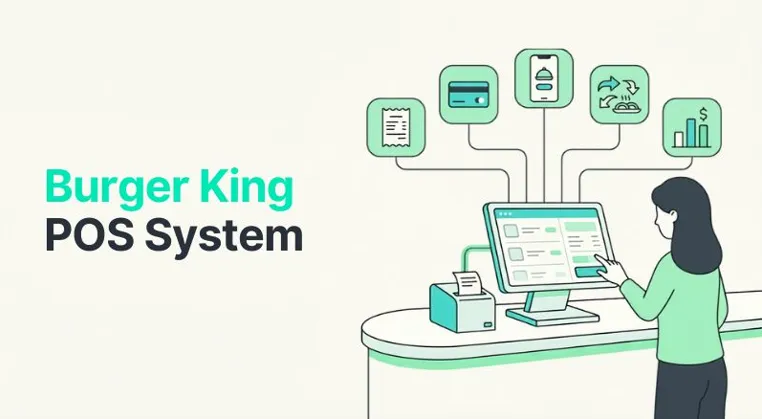
A typical transaction can involve several connected steps:
- Order entry: An employee, customer kiosk, app, or other ordering channel creates the order.
- Order processing: The POS records the products, modifiers, prices, discounts, and payment information.
- Order routing: Relevant order information is sent to the appropriate kitchen or fulfillment area.
- Payment: The customer pays using an available payment method.
- Preparation: Kitchen employees prepare the items according to the order.
- Fulfillment: The completed order is provided to the customer, collected at pickup, or handed to a delivery partner.
- Reporting: Transaction data becomes available for operational and business reporting.
The benefit is that these steps can operate as parts of a connected restaurant technology environment rather than separate systems.
Burger King POS System Software vs. a Standard Restaurant POS
A small independent restaurant may only need basic POS capabilities.
A global QSR operation has much more complicated requirements.
| Feature | Basic Restaurant POS | Burger King-Style QSR POS |
|---|---|---|
| Order processing | Yes | Yes |
| Payment processing | Yes | Yes |
| Kitchen routing | Sometimes | Essential |
| Drive-thru | Rare | Essential |
| Kiosks | Optional | Supported |
| Mobile ordering | Optional | Important |
| Delivery integration | Optional | Important |
| Centralized menu management | Limited | Important |
| Multi-location reporting | Basic | Advanced |
| Enterprise integrations | Limited | Extensive |
The biggest difference is scale and integration.
A Burger King POS software environment must support high transaction volumes and multiple customer touchpoints while maintaining consistent operational data.
Why Burger King Needs an Integrated POS System
The value of a restaurant POS system is not simply that it records sales.
For a large QSR brand, the POS becomes an important source of operational data.
An integrated system can help restaurants understand:
- Sales by location
- Popular menu items
- Order volume
- Transaction trends
- Digital ordering activity
- Operational performance
- Payment activity
- Customer ordering patterns
Burger King’s broader technology strategy also connects POS information with other restaurant technologies. In 2026, reporting on Burger King’s technology ecosystem described BK Assistant as bringing together information from areas such as inventory, kitchen equipment, POS data, employee schedules, and drive-thru operations.
This illustrates the direction of modern restaurant technology: instead of isolated applications, businesses increasingly use connected platforms.
Can You Buy the Same POS System Used by Burger King?
Not necessarily.
Burger King’s technology environment is designed around the operational requirements of a major restaurant chain. Franchisees may also be required to use approved systems or vendors that meet Burger King’s technology standards.
Burger King’s franchise documentation has specified that POS equipment and systems must meet company criteria and that franchisees must purchase POS systems from approved vendors under the brand’s POS policies.
For an independent restaurant, copying the exact Burger King technology stack may therefore be unnecessary.
Instead, restaurant owners should look for a POS system for Burger King-style operations that provides the capabilities they actually need. Knowing what to look for when buying a POS system can help operators compare features without paying for technology they do not actually require.
What to Look for in a Burger King-Style POS System
If you operate a busy QSR or fast-food franchise, prioritize these features:
Essential POS Features
- Fast touchscreen ordering
- Kitchen display system integration
- Drive-thru support
- Multiple payment options
- Inventory integration
- Employee management
- Sales reporting
- Cloud-based administration
- Menu and modifier management
Digital Features
- Online ordering
- Mobile ordering
- Self-service kiosks
- Delivery marketplace integration
- Loyalty integration
- Digital menu integration
- Centralized menu updates
Business Management Features
- Multi-location reporting
- Real-time sales data
- Labor management
- Inventory monitoring
- User permissions
- Analytics
- Automated reporting
The right system should reduce operational complexity rather than create another disconnected application for employees to manage.
Common Questions About the Burger King POS System
Does Burger King use Brink POS?
Burger King selected PAR Technology’s Brink POS as its exclusive POS software and services provider for traditional restaurants in North America. The rollout is part of a broader technology modernization effort.
Is Burger King’s POS system the same worldwide?
Not necessarily. POS technology can differ between markets and franchise operations. Public information also identifies Burger King operations using platforms such as Oracle Simphony in certain markets.
What does Burger King POS software do?
It can support order entry, payments, kitchen operations, digital ordering, drive-thru workflows, kiosks, menu management, reporting, and integrations with other restaurant technologies.
Can a small restaurant use a Burger King-style POS system?
Yes. A small restaurant may not need an enterprise platform, but it can choose a POS with similar capabilities, such as online ordering, kitchen integration, inventory management, payments, reporting, and multi-channel ordering.
Why is POS integration important for fast-food restaurants?
Integration reduces manual work and helps different parts of the restaurant share accurate order and sales information. This can improve speed, accuracy, reporting, and the overall customer experience.
Final Thoughts
The Burger King POS system is much more than a digital cash register. It is part of a larger restaurant technology ecosystem connecting orders, payments, kitchens, digital channels, kiosks, drive-thru operations, and business data.
For Burger King’s traditional North American restaurants, PAR Brink POS is the key platform selected for the brand’s POS modernization. However, Burger King’s global franchise network can include different technology environments depending on the market and operator.
If you’re researching a Burger King point of sale system because you operate a fast-food restaurant or franchise, focus less on copying a specific brand’s technology and more on the capabilities behind it. A strong restaurant POS should make ordering faster, connect every point of sale to the kitchen operations, and give management reliable data for better decisions.
Looking for a modern restaurant POS system? Choose a platform that can scale with your order volume, integrate your online and in-store channels, and simplify day-to-day restaurant operations.