Popeyes restaurants handle transactions from front counters, drive-thrus, mobile ordering, delivery platforms, and increasingly digital self-service channels. Keeping those orders organized requires much more than a traditional cash register.
The Popeyes POS system is part of a broader restaurant technology environment that helps franchise operators process transactions, manage orders, collect restaurant data, and connect customer-facing systems with back-of-house operations.
One important detail is often missed when discussing Popeyes POS technology: there is not enough reliable public evidence to describe every Popeyes restaurant as using one identical commercial POS product.
Popeyes franchise agreements instead require operators to install a point-of-sale system approved by the franchisor that meets Popeyes’ specifications. That distinction matters when determining what technology Popeyes actually uses.
What POS System Does Popeyes Use?
Popeyes requires franchisees to purchase, install, and use an approved POS System and an approved back-of-house system, commonly called a BOH system.
A current Popeyes franchise agreement states that both systems must meet franchisor specifications. It also gives the franchisor or its designated vendor the ability to retrieve restaurant information such as sales, menu mix, transaction-level data, inventory, and labor information.
That makes the Popeyes point-of-sale system more than a payment terminal.
It serves as an important data and operational connection between individual restaurants and the broader Popeyes restaurant network.
Public technology examples also show that different Popeyes franchise organizations have worked with different approved solutions.
For example, Pure Foods Management, which operates Popeyes restaurants, has used Xenial Encounter POS along with Xenial kitchen display, drive-thru, and back-office technology. Another Popeyes franchise case study documented the use of POS software. SICOM has also historically supported Popeyes franchise locations.
These examples should not be interpreted as evidence that every Popeyes restaurant uses the same vendor.
How Does the Popeyes POS System Work?
At the restaurant level, the Popeyes restaurant POS helps turn customer requests into recorded transactions that can move through payment and preparation workflows.
A typical transaction may follow this path:
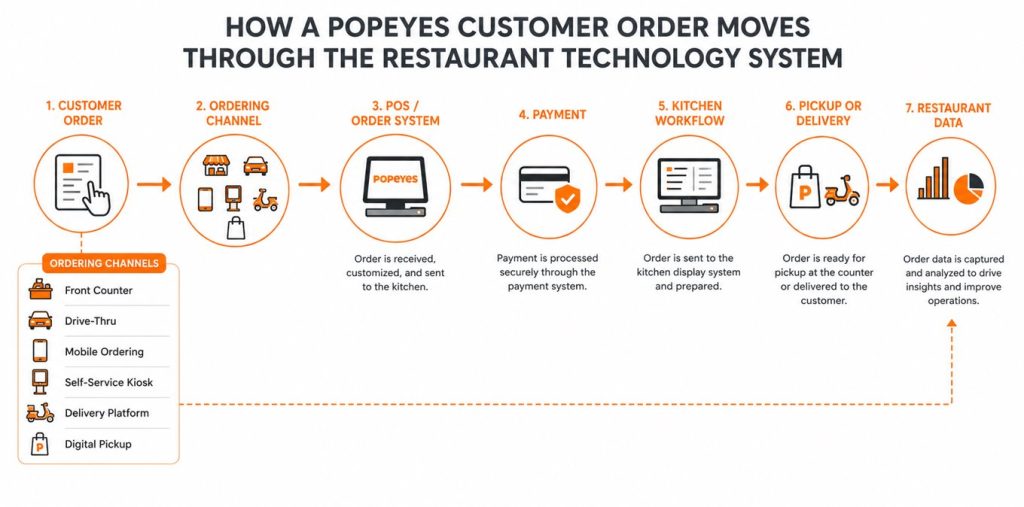
Customer order → Ordering channel → POS/order system → Payment → Kitchen workflow → Pickup or delivery → Restaurant data
However, customers can now begin that journey from several places.
Orders may originate through:
- Front-counter employees
- Drive-thru lanes
- Self-service kiosks
- Popeyes mobile ordering
- Delivery platforms
- Digital pickup channels
Popeyes has publicly discussed plans to increasingly integrate mobile order and pay, curbside pickup, digital pickup shelves, self-order kiosks, and Popeyes Rewards into restaurants.
The challenge for the POS environment is making those different ordering channels work together without unnecessarily complicating restaurant operations.
Key Popeyes POS System Features
The exact capabilities can vary by restaurant configuration and approved technology provider, but Popeyes’ public documents and restaurant technology initiatives reveal several important functions.
Order Entry and Transaction Processing
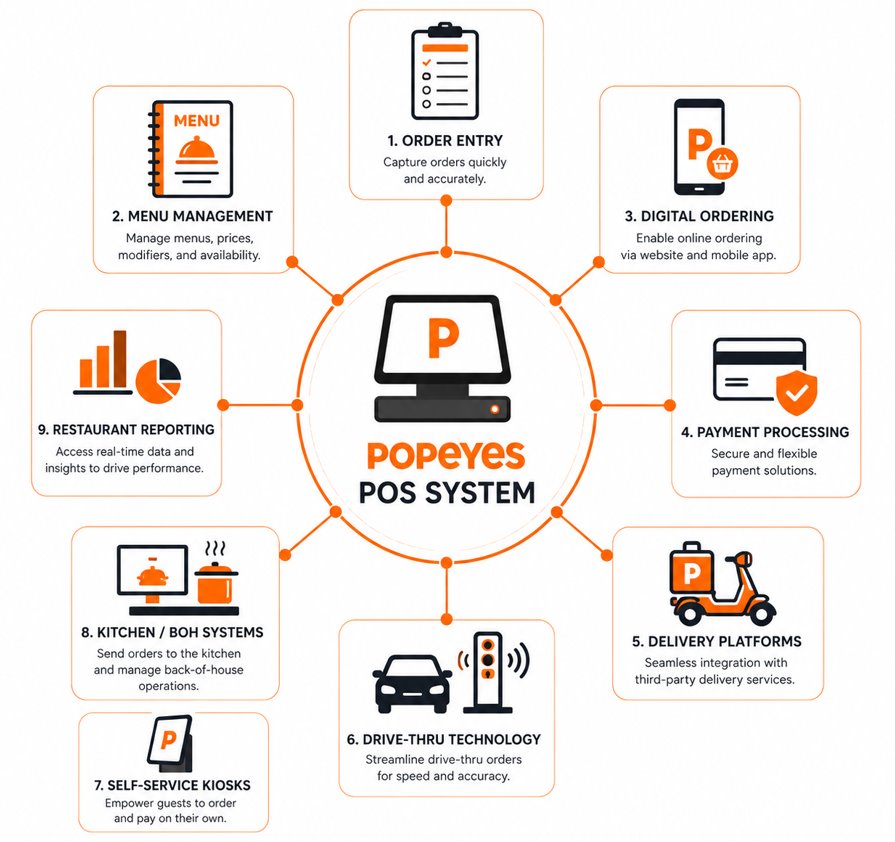
The core purpose of any Popeyes POS solution is to accurately record restaurant transactions.
A Popeyes franchise definition of the POS System describes technology capable of capturing information, including:
- Sales
- Sales taxes
- Individual items sold
- Product prices
- Coupon redemptions
- Transaction dates and times
- Product combinations
- Employees using the system
The system can also transmit this information according to Popeyes’ operational requirements.
For a quick-service restaurant, this creates a detailed digital record of restaurant activity rather than simply generating a receipt.
Menu and Product Management
Popeyes restaurants regularly deal with menu additions, limited-time offers, meal combinations, promotions, and product availability.
POS technology, therefore, needs a practical way to manage menu items and ensure that restaurant employees and digital ordering channels reflect current availability.
Public support documentation associated with Popeyes restaurant technology shows operators managing product availability across both POS and mobile ordering environments.
This demonstrates why menu synchronization is important.
If a product sells out, updating only the physical register while leaving it available for mobile customers can create refunds, substitutions, and frustrated guests.
Digital Ordering Integration
Modern Popeyes transactions are not limited to the front counter.
Popeyes has invested in mobile ordering, delivery, and other digital experiences for years. The brand has also expanded digital-order pickup areas and self-service ordering technology in newer restaurant designs.
That means Popeyes POS integration increasingly involves coordinating physical and digital ordering channels.
Ideally, restaurant employees should not need to manually recreate every digital order inside another system.
Connected ordering technology can help move customer information from the ordering channel into restaurant production and reporting systems more efficiently.
Third-Party Delivery Support
Delivery platforms create another source of restaurant orders.
Current Restaurant Brands International job listings for Popeyes restaurant technology specifically mention support for POS systems, digital menu boards, and third-party delivery platforms such as Uber Eats, Grubhub, and DoorDash.
This highlights the growing importance of integrations.
Without proper integration, employees may have to manage multiple tablets or manually transfer third-party orders, increasing the possibility of mistakes.
A connected Popeyes ordering system can simplify how those transactions reach restaurant operations.
Drive-Thru Technology
Drive-thru service is particularly important for quick-service restaurants, so Popeyes and its parent company, Restaurant Brands International, have invested heavily in drive-thru technology.
RBI previously announced plans to modernize thousands of drive-thru locations across its brands using digital menu boards capable of supporting predictive selling, loyalty integration, and remote contactless payments. Popeyes was included in that technology rollout.
Popeyes has also increasingly built double drive-thrus into new restaurants to improve capacity and speed of service.
The POS becomes one element within that environment, working alongside ordering technology, menu displays, payments, and kitchen systems.
Self-Service Kiosks
Popeyes has introduced self-order kiosks in modern restaurant designs.
Its redesigned Canal Street flagship restaurant in New Orleans, for example, includes self-order kiosks, digital order-ready boards, and designated areas for digital pickup.
Kiosks allow customers to browse the menu and place orders without requiring an employee to enter every transaction.
For that model to work well, kiosk orders need to integrate smoothly with restaurant production and transaction systems.
Back-of-House Integration
The Popeyes POS software environment works alongside back-of-house technology.
Popeyes franchise materials describe BOH systems that support restaurant functions such as:
- Inventory tracking
- Food-cost management
- Labor scheduling
- Labor management
- Restaurant reporting
The POS supplies important transaction data, while back-office tools turn that information into operational insights.
This distinction matters because some articles incorrectly treat every restaurant-management function as a POS feature.
In reality, POS and BOH applications often work together as separate but connected systems.
Restaurant Reporting and Data
Restaurant data is one of the most valuable outputs of modern POS technology.
Popeyes franchise agreements allow the franchisor or its designated vendor to retrieve data from POS and back-office systems, including:
- Sales
- Menu mix
- Transaction-level information
- Inventory
- Labor information
This allows the broader restaurant organization to better understand what is happening across franchise locations.
For restaurant operators, that same data can help identify sales patterns, popular products, labor needs, and operating trends.
Popeyes POS System for Franchisees
Popeyes operates primarily through a franchise model, which makes technology standardization especially important.
A franchisee cannot necessarily purchase any restaurant POS system they prefer and install it without considering brand requirements.
Current franchise language requires the operator to use POS and BOH systems that have been approved by Popeyes and meet its specifications. Popeyes can also require franchisees to implement additional ordering or digital systems and make necessary hardware, software, or wiring changes.
That structure can create several benefits across a large restaurant network:
- More consistent reporting
- Standardized transaction data
- Easier technology support
- Better digital integrations
- Consistent menu configurations
- Coordinated system upgrades
- More standardized restaurant workflows
It also means articles about a Popeyes POS system for franchisees should distinguish between brand requirements and the individual technology vendor installed by a particular restaurant operator.
Does Popeyes Use SICOM POS?
SICOM is strongly associated with Popeyes in historical restaurant technology sources.
Current integration directories continue to identify Popeyes among brands supported by SICOM, and older case studies document Popeyes franchise groups using SICOM technology.
However, saying simply “Popeyes uses SICOM POS” can be misleading.
Public examples also show Popeyes franchise organizations using Xenial and POSsible solutions.
The more accurate answer is that Popeyes franchisees must use approved systems that meet brand standards, while specific technology implementations can vary.
This is one of the most important distinctions when researching the Popeyes POS system.
Popeyes POS vs. a Typical Independent Restaurant POS
| Area | Popeyes Technology Approach | Typical Independent Restaurant |
|---|---|---|
| POS selection | Must meet brand approval | The owner normally chooses |
| Restaurant network | Large franchise system | Usually, one or several locations |
| Menu management | Brand-driven requirements | Owner-controlled |
| Mobile ordering | Brand digital ecosystem | POS or third-party solution |
| Delivery | Integrated with major platforms | Integration varies |
| Drive-thru technology | Major operational priority | Depends on restaurant |
| Kiosks | Used in modern formats | Optional |
| Reporting | Restaurant and franchise data requirements | Owner-focused reporting |
| Back-office systems | Approved BOH environment | Vendor-dependent |
| Technology upgrades | May be brand-required | Owner decides |
Independent restaurants have much more freedom, but Popeyes’ approach demonstrates why standardization becomes increasingly valuable as a restaurant organization grows.
What Restaurants Can Learn From Popeyes’ POS Strategy
You do not need thousands of locations to apply the same principles.
Independent restaurants and smaller chains can use Popeyes’ technology strategy as a checklist when choosing restaurant POS software.
Connect Your Ordering Channels
Counter, mobile, delivery, kiosk, and drive-thru transactions should not operate as disconnected islands.
Look for integrations that reduce duplicate order entry and make it easier for employees to manage multiple channels.
Keep Menus Synchronized
Menu availability should remain consistent between your physical POS and digital ordering channels.
If an item sells out, employees should have a practical process for removing it across every customer touchpoint.
Connect POS and Back-Office Data
Sales information becomes more valuable when combined with inventory, food-cost, and labor data.
A restaurant owner should evaluate how easily the POS exchanges information with accounting and management systems.
Design Around Peak Demand
Popeyes’ investments in double drive-thrus, kiosks, pickup areas, and digital ordering demonstrate an important lesson: technology should solve operational bottlenecks.
Identify where customers wait the longest and select tools that address that specific problem.
Prioritize Integration Over Feature Count
A POS with 200 features is not automatically better than one with 50.
What matters is whether the features your restaurant actually uses work reliably together.
Common Mistakes When Choosing a Restaurant POS
Restaurant owners researching large chains such as Popeyes sometimes focus too much on finding the exact same hardware or software.
That can lead to poor purchasing decisions.
Common mistakes include:
- Copying an enterprise restaurant’s technology stack
- Choosing hardware before evaluating software
- Ignoring payment-processing costs
- Failing to test online-order integrations
- Overlooking kitchen workflows
- Buying unnecessary features
- Ignoring employee training requirements
- Selecting a system without reliable support
- Failing to consider future locations
The better approach is to understand why Popeyes uses connected restaurant technology and apply those principles according to your own operation.
FAQs About the Popeyes POS System
What POS system does Popeyes use?
Popeyes franchisees are required to use a POS system approved by the franchisor and meeting Popeyes’ specifications. Public examples show Popeyes franchise organizations using vendors such as SICOM, Xenial, and POSsible, so it is inaccurate to assume every location currently uses one identical commercial POS platform.
Does Popeyes use SICOM POS?
Some Popeyes operators have used SICOM technology, and current integration directories continue to associate SICOM with Popeyes. However, public evidence also documents other approved POS solutions at different Popeyes franchise organizations.
What does the Popeyes POS system track?
Popeyes franchise documentation describes POS technology that can record and transmit information, including sales, taxes, item prices, coupons, transaction times, products sold, and employees using the system.
Does Popeyes use self-service kiosks?
Yes. Popeyes has deployed self-order kiosks in modern restaurant formats and has identified kiosks as part of its broader plans to improve digital ordering and the guest experience.
Can Popeyes franchisees choose their own POS?
Not freely. Franchise agreements require franchisees to use a POS system approved by Popeyes and meeting its specifications. The brand can also establish requirements for additional ordering and digital systems.
Conclusion
The Popeyes POS system is best understood as part of a connected restaurant technology environment rather than a single cash register or universal software product.
Popeyes requires franchise restaurants to use approved POS and back-of-house systems, while its broader technology strategy connects restaurant transactions with mobile ordering, third-party delivery, self-service kiosks, drive-thru technology, digital menu systems, restaurant reporting, and operational data.
Public examples demonstrate that Popeyes franchise groups have used different approved POS platforms, which is why identifying one vendor as the definitive system for every Popeyes location can be misleading.
For other restaurant owners, the larger lesson is more valuable than the vendor name. Choose a POS that can reliably connect payments, ordering channels, kitchen workflows, reporting, and back-office operations without making daily work harder for employees.
If you’re evaluating a new restaurant POS solution, compare the complete technology ecosystem and integrations—not just the terminal sitting at the front counter.