Telehealth billing can become confusing when a patient receives care outside a traditional medical office. One of the most important details is choosing the correct Place of Service (POS) code based on where the patient is physically located during the telehealth encounter.
For Medicare professional telehealth billing, POS 10 generally identifies an eligible telehealth service provided while the patient is at home. But POS 10 alone does not make a service covered or payable. The service must also meet current Medicare telehealth, coding, practitioner, and documentation requirements.
Several major Medicare telehealth flexibilities have also been extended through December 31, 2027, making current guidance especially important for practices billing telehealth services in 2026.
Quick Answer: What Does POS 10 Mean?
POS 10 means “Telehealth Provided in Patient’s Home.” For Medicare professional billing, it identifies telehealth services received while the patient is physically located in their home, rather than at another facility or location.
A simple way to remember it is:
Patient at home + eligible telehealth service = consider POS 10.
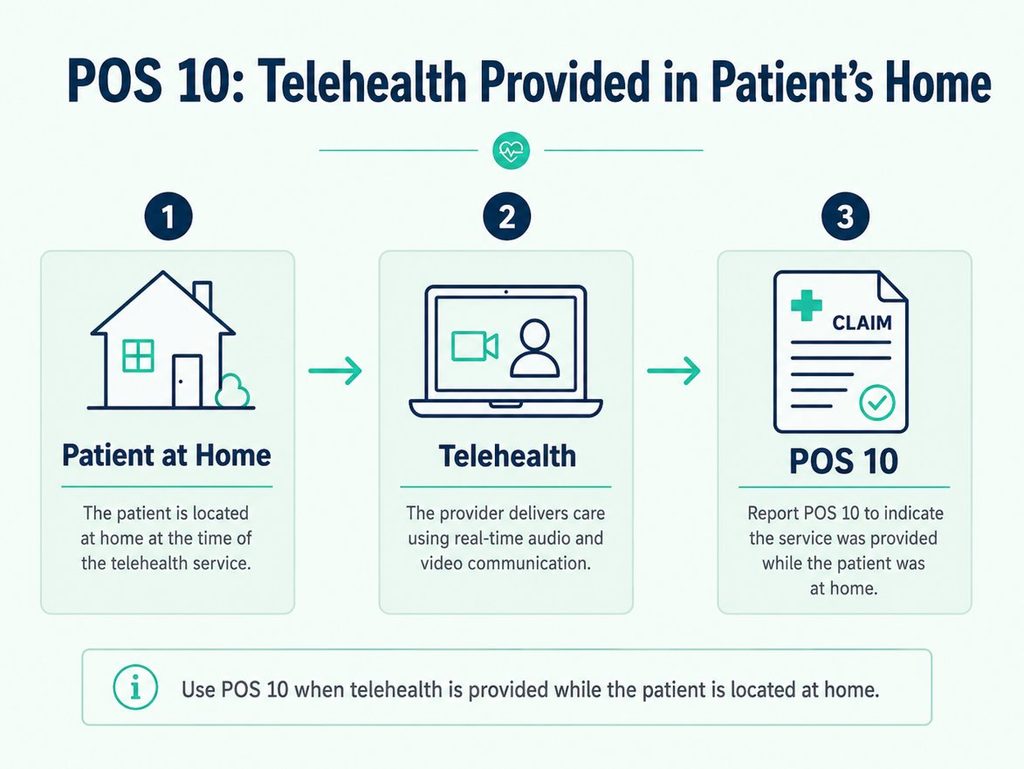
However, POS 10 only identifies the patient’s place of service. It does not automatically mean the service qualifies for Medicare telehealth coverage or guarantees reimbursement.
What Is POS 10 in Medical Billing?
Place of Service codes are two-digit codes used on healthcare claims to identify the setting where a service was provided or received.
The POS code set was updated effective January 1, 2022 to revise POS 02 and add the new POS 10. CMS implemented the Medicare claims-processing changes in April 2022. The update gave payers more specific information about whether a telehealth patient was located at home or somewhere else.
The official description of POS 10 is:
Telehealth Provided in Patient’s Home
For Medicare professional billing, the code applies when the patient receives health services through telecommunications technology while physically located in their private residence.
This distinction matters because patient location can affect how a Medicare telehealth claim is reported and paid.
When Should POS 10 Be Used?
For Medicare professional telehealth billing, the main question is:
Where was the patient physically located when the telehealth service occurred?
CMS instructs physicians and practitioners to use:
- POS 10 for telehealth provided while the patient is at home.
- POS 02 for telehealth provided while the patient is somewhere other than home.
The patient’s location—not simply the provider’s location—is what distinguishes POS 10 from POS 02.
Keep in mind that Medicaid programs, Medicare Advantage plans, and commercial insurers may apply different billing or reimbursement requirements. Always verify the individual payer’s current policy.
Example 1: Patient at Home
A patient joins an eligible telehealth appointment from their home while the physician provides the service from a medical office.
Likely Medicare professional POS: 10
The patient is physically located at home.
Example 2: Patient at Work
A patient participates in an eligible telehealth visit while physically located at their workplace.
Likely Medicare professional POS: 02
The important fact is simply that the patient is not at home.
Example 3: Patient at Another Location
A patient receives an eligible telehealth service from somewhere other than their private residence.
Likely Medicare professional POS: 02
The exact billing requirements should still be checked against current Medicare and service-specific rules.
Example 4: Provider Is Working From Home
A physician conducts an eligible telehealth visit from a home office while the patient is also physically located in the patient’s home.
Likely Medicare professional POS: 10
The provider working from home does not, by itself, change the POS 10 versus POS 02 determination.
POS 10 Does Not Automatically Mean the Service Is Covered
This is one of the most important points for medical billing teams.
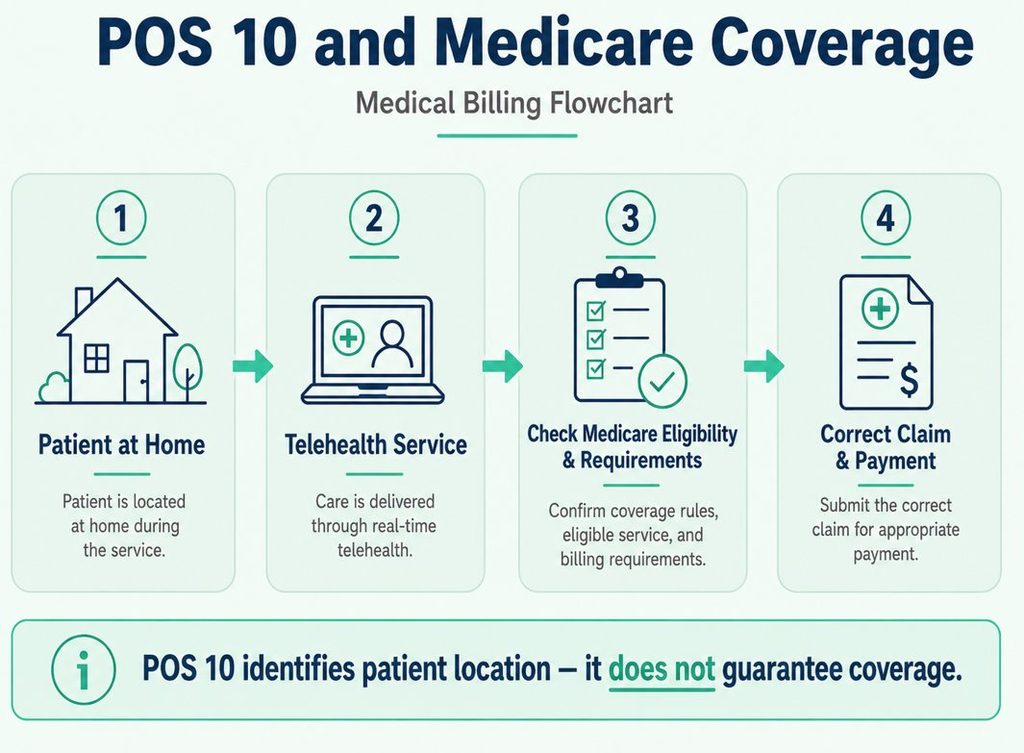
POS 10 tells Medicare where the patient was located. It does not determine by itself whether the service qualifies as a covered Medicare telehealth service.
CMS maintains a specific list of services payable under the Medicare Physician Fee Schedule when furnished through telehealth. The service being billed must still satisfy the applicable coverage and billing requirements.
Depending on the service, billing teams may need to confirm:
- Whether the CPT or HCPCS service is telehealth eligible
- Whether the practitioner is eligible to furnish the service
- Whether the technology used meets Medicare requirements
- Whether additional coding requirements apply
- Whether documentation supports the service
- Whether payer-specific requirements are satisfied
Think of POS 10 as one part of a correctly coded telehealth claim, not as proof that Medicare must pay the claim.
POS 10 vs POS 02: What’s the Difference?
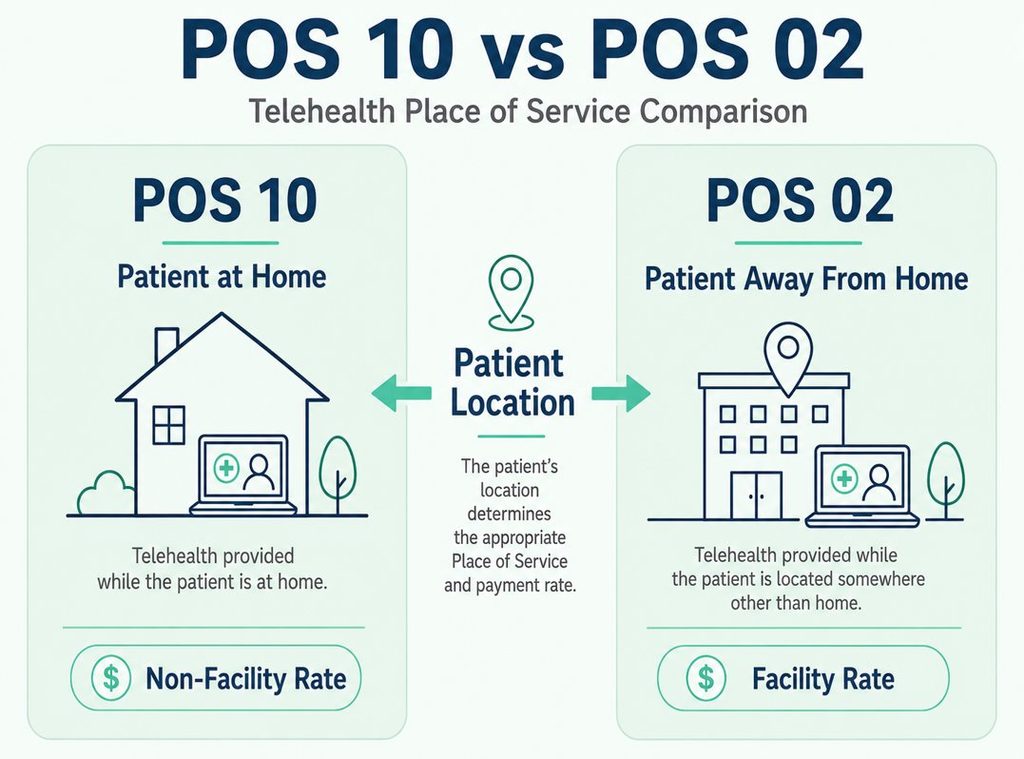
POS 10 and POS 02 both identify telehealth encounters in Medicare professional billing, but the patient’s location separates them.
| Factor | POS 10 | POS 02 |
|---|---|---|
| Official description | Telehealth Provided in Patient’s Home | Telehealth Provided Other than in Patient’s Home |
| Patient location | Home | Somewhere other than home |
| Service delivery | Telehealth | Telehealth |
| Medicare PFS payment approach | Non-facility rate | Facility rate |
| Main deciding factor | Patient is at home | Patient is not at home |
CMS’s current telehealth guidance instructs physicians and practitioners to use these codes for Medicare professional telehealth billing based on the patient’s location.
Since January 1, 2024, Medicare has paid covered telehealth services furnished to patients in their homes at the non-facility Physician Fee Schedule rate when reported under the applicable policy.
POS 10 vs POS 11 vs POS 12
POS 10 is sometimes confused with other common medical billing Place of Service codes.
| POS Code | Meaning | Typical Situation |
|---|---|---|
| POS 10 | Telehealth Provided in Patient’s Home | Eligible telehealth encounter while patient is at home |
| POS 02 | Telehealth Provided Other than in Patient’s Home | Eligible telehealth encounter while patient is away from home |
| POS 11 | Office | Patient receives care in a physician or practitioner’s office |
| POS 12 | Home | Service is physically furnished in the patient’s private residence |
The easiest distinction between POS 10 and POS 12 is the way care is delivered.
POS 10 identifies a telehealth encounter received while the patient is at home.
POS 12 identifies the patient’s home as the physical place where an in-person service is furnished.
For example, a physician conducting an eligible video visit with a patient sitting at home may use POS 10 under Medicare professional telehealth rules. A clinician physically traveling to the patient’s home to perform an applicable service would not use POS 10 merely because the patient was at home.
How Does POS 10 Affect Medicare Reimbursement?
For covered Medicare professional telehealth services, POS can influence the Physician Fee Schedule payment calculation.
CMS states that Medicare pays covered telehealth services provided to patients in their homes at the non-facility PFS rate under the policy effective since January 1, 2024.
However, that does not mean all POS 10 claims receive the same reimbursement.
Payment may depend on factors including:
- CPT or HCPCS code
- Geographic adjustment
- Provider type
- Applicable PFS values
- Coverage requirements
- Service-specific rules
- Other claim details
A billing team should therefore avoid treating POS 10 as a fixed reimbursement rate.
Key Medicare Telehealth Updates for 2026
A 2026 POS 10 guide also needs to account for broader Medicare telehealth changes.
Several Major Telehealth Flexibilities Continue Through 2027
Under current federal law and CMS guidance, several major Medicare telehealth flexibilities have been extended through December 31, 2027.
During this period, Medicare beneficiaries can generally continue receiving Medicare telehealth services without the pre-pandemic requirement that most patients be located in a rural area and at a qualifying medical facility. CMS states that beneficiaries can receive Medicare telehealth services broadly across the United States and territories through the end of 2027.
An expanded range of practitioners can also continue furnishing Medicare telehealth services through December 31, 2027. This includes professionals such as physical therapists, occupational therapists, speech-language pathologists, and audiologists where applicable.
Certain audio-only telehealth flexibilities and other temporary provisions also continue under current law, depending on the type of service and billing setting.
These are extensions of specific Medicare telehealth flexibilities, not a statement that every telehealth policy has been extended unchanged through 2027.
Telehealth Frequency Limits Were Permanently Removed for Certain Services
Beginning January 1, 2026, CMS permanently removed Medicare telehealth frequency limitations for:
- Subsequent inpatient visits
- Subsequent nursing facility visits
- Critical care consultations
This change was finalized in the CY 2026 Physician Fee Schedule rule.
CMS Changed How Services Are Added to the Telehealth List
For 2026, CMS streamlined its process for adding services to the Medicare Telehealth Services List.
CMS removed the prior distinction between provisional and permanent additions and revised the review approach for determining whether services can appropriately be furnished through interactive telecommunications technology.
CMS also added several services to the 2026 Medicare telehealth list, including certain psychotherapy, obesity counseling, infectious disease, and auditory-related services.
Virtual Direct Supervision Rules Changed in 2026
CMS also finalized broader use of virtual presence for certain services requiring direct supervision beginning January 1, 2026.
Under applicable requirements, a supervising physician or practitioner may satisfy direct-supervision requirements through real-time audio/video communication technology, excluding audio-only technology, for qualifying services. Some exceptions and service-specific conditions apply.
These changes are another reason practices should avoid relying on old telehealth billing guides.
When Should You Not Use POS 10?
For Medicare professional claims, POS 10 should not automatically be used just because technology was involved.
POS 10 may not be appropriate when:
- The patient receives telehealth somewhere other than home
- The patient receives an in-person office service
- A healthcare professional physically visits the patient’s home
- The billed service is not eligible under applicable telehealth requirements
- A different Medicare billing methodology applies
- The payer requires a different reporting approach
A simple rule is:
First identify how the service was delivered. Then identify where the patient was physically located. Finally, verify the payer’s current rules.
How to Use POS 10 on a Medical Claim
A consistent workflow can help reduce Place of Service errors.
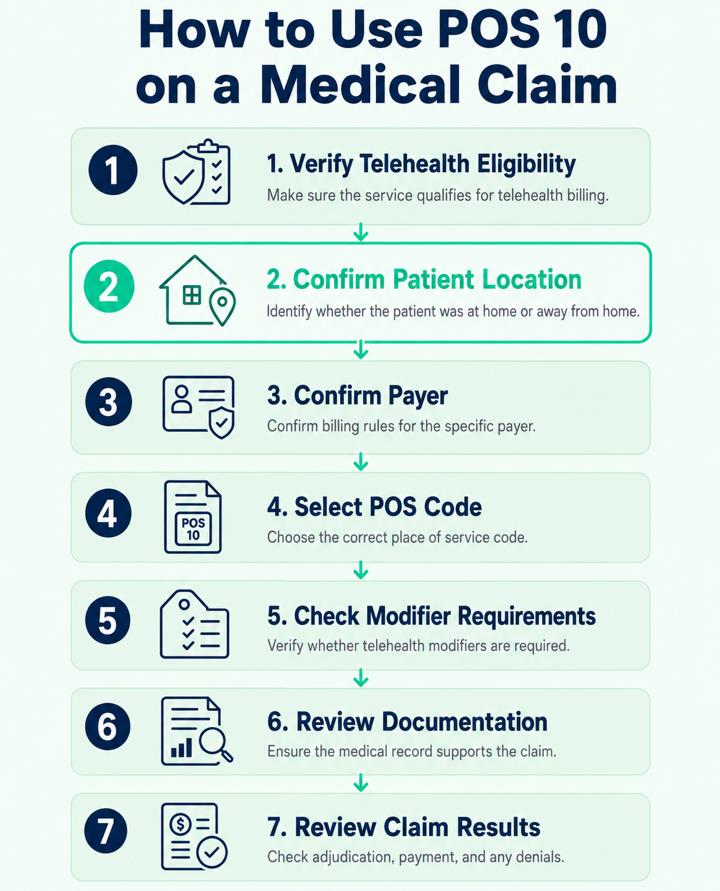
1. Verify Telehealth Eligibility
Confirm that the service is currently payable through Medicare telehealth when applicable.
CMS publishes the List of Telehealth Services for Calendar Year 2026, which identifies services payable under the Medicare Physician Fee Schedule when furnished through telehealth.
2. Confirm the Patient’s Physical Location
Determine and document where the patient was during the encounter.
For Medicare professional billing:
- Patient at home → consider POS 10
- Patient away from home → consider POS 02
3. Confirm the Payer
Do not automatically apply Original Medicare rules to every patient.
Verify requirements for:
- Original Medicare
- Medicare Advantage
- Medicaid
- Commercial insurance
4. Select the Appropriate POS
Use the patient’s location and the applicable billing rules to select the correct Place of Service code.
For Medicare professional telehealth billing, CMS currently identifies POS 02 and POS 10 as the relevant telehealth POS codes.
5. Check Whether a Modifier Is Required
For applicable Medicare professional telehealth claims, POS 02 or POS 10 should be reported with the appropriate telehealth modifier based on how the service was delivered. CMS guidance identifies modifier 93 for qualifying audio-only telehealth services and modifier 95 for qualifying audio-video telehealth services in applicable professional billing situations.
Modifier requirements can vary by service, provider type, billing setting, and payer. Before submitting a claim, verify the current CMS, Medicare Administrative Contractor (MAC), or payer-specific instructions to make sure the correct modifier is reported
6. Review Documentation
The medical record should support:
- The service performed
- Telehealth modality when relevant
- Patient location
- Medical necessity
- Applicable coverage requirements
Accurately recording patient location can make POS selection easier for the billing team.
7. Review Claim Results
Monitor claims for:
- Denials
- Coding edits
- Unexpected payment differences
- Requests for additional information
- Payer-specific POS issues
For Medicare-specific billing questions, practices can also consult their Medicare Administrative Contractor (MAC).
Common POS 10 Billing Mistakes
Using POS 10 for Every Telehealth Visit
Not every patient receives telehealth at home.
If an eligible Medicare telehealth service is provided while the patient is somewhere other than home, POS 02 may be appropriate instead.
Assuming POS 10 Guarantees Coverage
POS 10 only identifies patient location in the telehealth context.
The CPT or HCPCS service and other claim requirements must separately qualify for Medicare coverage and payment.
Confusing POS 10 With POS 12
Both can involve a patient physically located at home.
But POS 10 means telehealth at home, while POS 12 means the service itself is physically furnished in the patient’s home.
Choosing the Code Based on the Provider’s Location
A physician might provide telehealth from an office, clinic, hospital, or home office.
For the Medicare POS 02 versus POS 10 distinction, focus on where the patient is located.
Automatically Adding Telehealth Modifiers
Modifier rules are not identical for every Medicare claim or payer.
Check the specific billing instructions rather than assuming every POS 10 claim requires modifier 93 or 95.
Following Outdated Telehealth Rules
Medicare telehealth requirements have changed repeatedly since the COVID-19 public health emergency.
In 2026 alone, CMS changed the telehealth-list review process, permanently removed certain frequency limits, expanded virtual direct-supervision policies, and implemented other policy updates. At the same time, federal legislation extended several important flexibilities through December 31, 2027.
Assuming Every Payer Uses Medicare Rules
Commercial insurers, Medicare Advantage plans, and Medicaid programs may have their own telehealth billing requirements.
Always check the payer before applying Medicare rules to a non-Medicare claim.
POS 10 Billing Checklist
Before submitting a Medicare professional telehealth claim with POS 10, confirm:
- Was the patient physically at home during the encounter?
- Was the service actually furnished through telehealth?
- Is the CPT or HCPCS service eligible for Medicare telehealth?
- Is the practitioner eligible to furnish the service?
- Is POS 10 correct for this claim and billing setting?
- Are any modifiers required for this specific service?
- Does documentation support the patient’s location and service?
- Have you checked current CMS or MAC guidance?
- For non-Original Medicare claims, have you confirmed the payer’s rules?
Patient Payment Processing Is Separate From POS 10 Billing
It is important not to confuse POS 10 as a Place of Service code with a POS system used to accept patient payments.
Medical billing determines how practices submit claims to Medicare and other insurers. Patient payment processing handles transactions such as patient balances, copays, deductibles, and other eligible charges.
A practice may therefore submit an insurance claim using POS 10 while separately collecting a patient’s financial responsibility through its payment platform.
Swyft POS provides payment-processing technology for businesses, including payment gateways and electronic payment tools. Its published payment-gateway information describes encryption and payment security features used to protect transaction data.
For medical offices exploring new payment technology, the goal should be to keep insurance billing and patient payments clearly separated while making both workflows easier to manage.
Looking for a better way to manage in-person and remote patient payments? Explore Swyft POS payment solutions for your practice.
Frequently Asked Questions About POS 10
What does POS 10 mean in medical billing?
POS 10 means Telehealth Provided in Patient’s Home. For Medicare professional billing, it is used to identify an eligible telehealth encounter when the patient is physically located in their home.
Is POS 10 only used for telehealth?
Yes. POS 10 specifically identifies telehealth provided while the patient is at home. A service physically performed by a healthcare professional in the patient’s home is not POS 10 simply because the patient is home.
Does POS 10 mean Medicare will cover the service?
No. POS 10 does not establish coverage by itself. The service must also meet applicable Medicare telehealth coverage, coding, practitioner, technology, and billing requirements. CMS maintains a separate list of services payable under the Physician Fee Schedule when furnished via telehealth.
What is the difference between POS 02 and POS 10?
For Medicare professional telehealth billing, POS 10 applies when the patient is at home. POS 02 applies when the patient receives telehealth somewhere other than home.
Is POS 10 the same as POS 12?
No. POS 10 identifies telehealth received at home. POS 12 identifies the home as the location where a service is physically furnished.
The two codes should not be used interchangeably.
Does Medicare pay POS 10 at the non-facility rate?
For covered Medicare professional telehealth services provided to patients at home under the applicable policy, CMS uses the non-facility Physician Fee Schedule rate. Actual reimbursement still depends on the service and other payment factors.
Were Medicare telehealth rules extended through 2027?
Several important Medicare telehealth flexibilities have been extended through December 31, 2027. These include broader location flexibility and an expanded range of practitioners who may furnish Medicare telehealth during the extension period. This does not mean every Medicare telehealth policy is temporarily extended or unchanged.
Do POS 10 claims always require modifier 95?
No. Modifier requirements depend on the specific service, provider, payer, billing setting, and claim type. Practices should verify current CMS, MAC, and payer-specific instructions rather than automatically adding modifier 95 to every POS 10 claim.
Do commercial insurers follow the same POS 10 rules as Medicare?
Not necessarily. Commercial insurance plans, Medicare Advantage organizations, and Medicaid programs may have different telehealth billing and reimbursement policies. Always check the requirements of the payer receiving the claim.
Final Takeaway
POS 10 identifies telehealth provided while the patient is physically located at home. For Medicare professional telehealth billing, POS 02 generally applies when the patient receives an eligible telehealth service somewhere other than home.
But patient location is only one part of the billing decision.
Before submitting a POS 10 claim, confirm that the service is telehealth eligible, the practitioner and technology meet applicable requirements, documentation supports the encounter, and any additional coding rules have been followed.
Practices should also stay current with Medicare policy. Several major telehealth flexibilities now continue through December 31, 2027, while CMS made additional permanent and policy-specific changes beginning in 2026.
Key Takeaway: For Medicare professional telehealth billing, start with the patient’s location. At home points toward POS 10; away from home points toward POS 02. Then separately verify that the service itself qualifies for coverage and that all current billing requirements are met.
This article is for general informational purposes only and is not legal, medical, reimbursement, or professional coding advice. Medicare and payer requirements can change and may vary by service, provider, setting, and insurance plan. Verify current CMS, MAC, and payer guidance before submitting claims.