When a healthcare professional provides care in a patient’s home, choosing the correct Place of Service (POS) code is an important part of accurate medical billing.
POS 12 identifies the patient’s home as the place where an in-person healthcare service is furnished. It should not be confused with POS 10, which applies to telehealth received while the patient is at home.
For Medicare and other professional claims, getting that distinction right helps the payer understand where the service actually occurred.
Quick Answer: What Does POS 12 Mean?
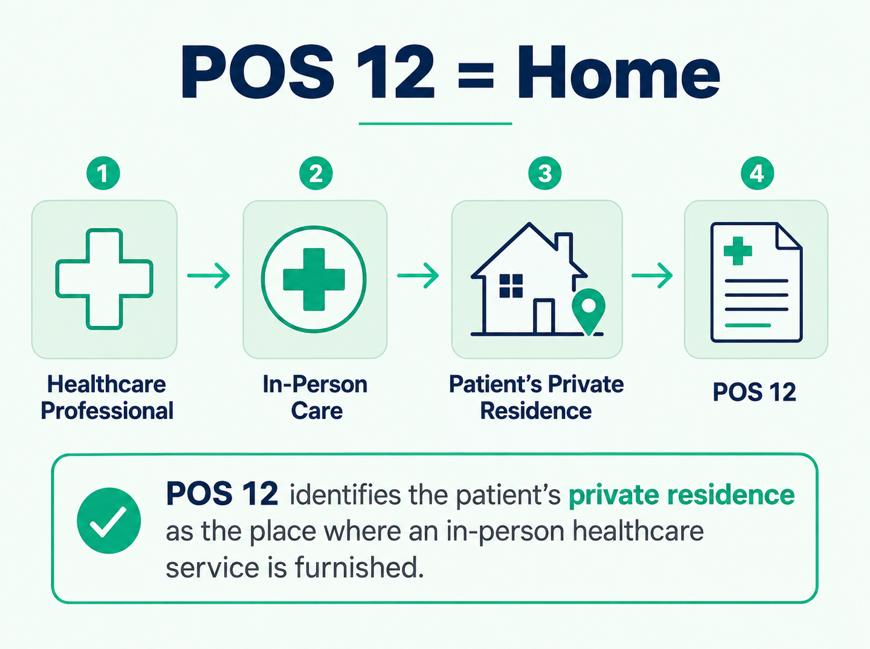
POS 12 means “Home.” CMS defines it as a location, other than a hospital or other facility, where the patient receives care in a private residence.
A simple way to remember it is:
In-person care is furnished in the patient’s private residence = consider POS 12, subject to the service and payer’s requirements.
POS 12 identifies the place where the service was furnished. It does not automatically mean that every service performed in the home is covered, medically necessary, or payable by Medicare or another insurer.
What Is POS 12 in Medical Billing?
Place of Service codes are two-digit codes used on professional healthcare claims to identify the setting where a service was furnished. CMS maintains the national POS code set used across the healthcare industry.
The official definition of POS 12 is:
Home — Location, other than a hospital or other facility, where the patient receives care in a private residence.
In practical terms, POS 12 may apply when a physician or other qualified healthcare professional physically travels to a patient’s private residence and performs an eligible service there.
The key words are private residence and care delivered there.
Has POS 12 Changed in 2026?
CMS’s Place of Service code page was updated in 2026, but the current POS database continues to list POS 12 as Home with the same private-residence definition. I did not identify a new 2026 definition or major coding change specifically for POS 12 in the current CMS code set.
That means practices should focus less on searching for a new POS 12 definition and more on applying the existing code correctly.
Current Medicare billing manuals and payer requirements should still be checked before submitting claims because reimbursement and service-specific rules can change even when the POS definition itself does not.
When Should POS 12 Be Used?
For professional claims, start with one question:
Where was the patient physically located when the healthcare professional furnished the service?
POS 12 generally points to situations where:
- The patient is in a private residence
- The healthcare professional is physically present there
- The service is appropriately furnished in the home
- The billed service meets applicable coverage and coding requirements
CMS specifically states that, for certain Medicare physician home or residence E/M services reported with POS 12, the physician must actually be present in the beneficiary’s home.
Example 1: Physician Makes a House Call
A physician travels to a patient’s private residence and performs an eligible evaluation and management service in person.
Likely POS: 12
The service is physically furnished in the patient’s home.
Example 2: Nurse Practitioner Visits the Patient at Home
An eligible practitioner provides a covered professional service while physically present in the patient’s private residence.
POS 12 may apply, depending on the service, provider qualifications, and payer requirements.
Example 3: Patient Visits the Doctor’s Office
The patient travels to the physician’s medical office for an in-person appointment.
Likely POS: 11
The service occurred in an office, not at home.
Example 4: Patient Has a Video Visit From Home
A patient sits at home and receives a qualifying telehealth service from a practitioner located elsewhere.
For Medicare professional telehealth billing, this generally points to:
POS 10 — not POS 12.
That difference is one of the most important POS 12 billing rules to understand.
POS 12 vs POS 10: What’s the Difference?
POS 12 and POS 10 can both involve a patient who is physically at home, but they describe different ways of delivering care.
| Factor | POS 12 | POS 10 |
|---|---|---|
| Official name | Home | Telehealth Provided in Patient’s Home |
| Patient location | Private residence | Private residence |
| Provider physically at home | Generally yes for an in-person home service | No requirement for provider to be physically with patient |
| How care is delivered | In person | Through telecommunications technology |
| Main distinction | Service is physically furnished in the home | Telehealth is received in the home |
CMS defines POS 10 separately as telehealth provided while the patient is located in their home, while POS 12 identifies the home itself as the place where care is furnished.
The easiest rule is:
Provider comes to the patient = POS 12 may apply.
Telehealth comes to the patient = POS 10 may apply.
POS 12 vs POS 11, 13, 14, and 16
Several POS codes describe settings that can look residential but are not necessarily POS 12.
| POS Code | Setting | Typical Meaning |
|---|---|---|
| POS 11 | Office | Professional office setting |
| POS 12 | Home | Patient’s private residence |
| POS 13 | Assisted Living Facility | Congregate residential facility with support services |
| POS 14 | Group Home | Shared residence with supervision or related services |
| POS 16 | Temporary Lodging | Hotel, hostel, campground, resort or similar temporary accommodation |
CMS provides separate codes for these settings, so billers should not use POS 12 simply because a location feels residential.
For example, an assisted living facility has its own POS 13, while temporary lodging is POS 16.
The actual setting matters.
Does POS 12 Mean the Patient Must Be Homebound?
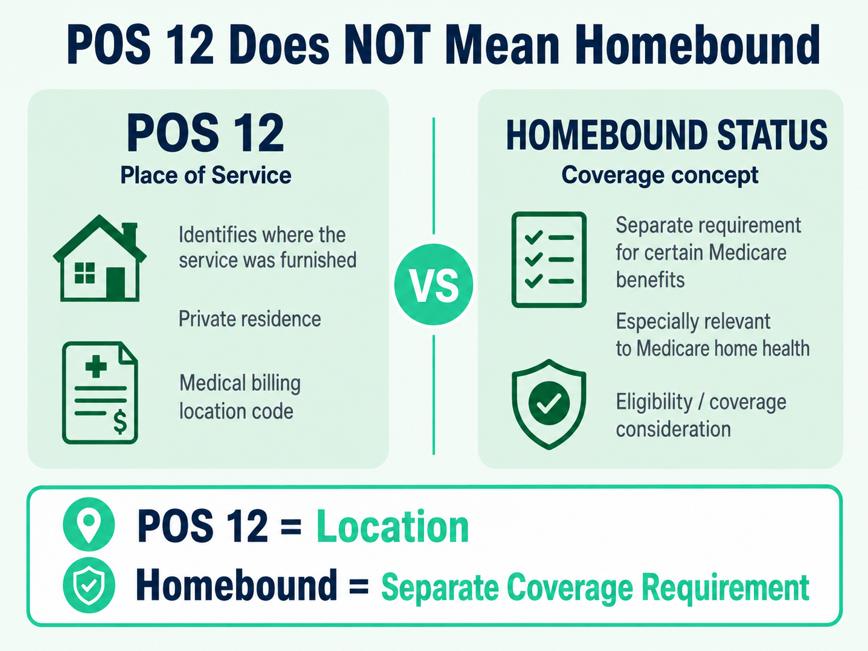
Not necessarily.
This is an important Medicare distinction.
CMS states that under the Medicare home health benefit, a beneficiary generally must meet the applicable homebound requirements for covered home health services.
However, for physician home or residence services reported under the applicable Medicare professional billing rules, the beneficiary does not have to be confined to the home simply because POS 12 is used.
So:
POS 12 does not automatically equal “homebound.”
It identifies the location of the service.
Homebound status is a separate coverage concept that may apply to certain Medicare benefits, especially the home health benefit.
Does POS 12 Mean the Patient Is Receiving Home Health Services?
No.
POS 12 is a place-of-service code, not a home health benefit designation.
It tells the payer that the professional service occurred in the patient’s private residence.
A physician making an in-person house call may use POS 12 even though the patient is not enrolled in Medicare’s home health benefit.
Similarly, not every service provided by a home health agency is billed through the same professional claim rules used by physicians and practitioners.
The type of service, billing provider, claim type, and benefit involved all need to be evaluated separately.
Does POS 12 Automatically Mean Medicare Will Pay the Claim?
No.
Using the correct POS code is only one part of a payable claim.
The service must still meet applicable requirements, which may include:
- Medicare coverage rules
- Medical necessity
- Correct CPT or HCPCS coding
- Provider eligibility
- Documentation requirements
- Frequency limitations
- Applicable modifiers
- Payer-specific policies
CMS advises providers to check reimbursement policies with the individual payer because Medicare, Medicaid, and private insurers may apply different requirements.
Physician Presence and POS 12
For Medicare physician home or residence E/M services covered by CMS’s applicable home-visit rules, the physician must actually be present in the beneficiary’s home.
CMS’s current Medicare Claims Processing Manual states that a physician cannot bill the applicable home visit service with POS 12 unless the physician was actually present in the beneficiary’s home.
This prevents practices from treating a remote or telehealth encounter as an in-person home visit.
If the patient is at home but the practitioner is providing the encounter through telecommunications technology, Medicare’s telehealth POS rules should be reviewed instead.
How Does POS 12 Affect Medicare Reimbursement?
Place of Service can affect how Medicare calculates payment under the Physician Fee Schedule (PFS).
CMS explains that Physician Fee Schedule payments vary depending on the setting because the practice expenses associated with furnishing a service may differ between facility and non-facility environments. Services furnished in beneficiaries’ homes are among the settings in which physicians and practitioners may receive payment under the PFS.
However, POS 12 should not be treated as a guarantee of a specific reimbursement amount.
Payment can depend on:
- Procedure or service code
- Provider type
- Geographic locality
- Relative value units
- Medical necessity
- Coverage requirements
- Modifiers
- Other Medicare payment rules
Practices can use CMS’s Physician Fee Schedule tools or contact their Medicare Administrative Contractor when exact reimbursement guidance is needed.
Where Is POS 12 Reported on a Professional Claim?
On the paper CMS-1500 professional claim form, Place of Service is reported in Item 24B.
CMS states that Item 24B is required and should contain the appropriate POS code identifying the setting for each service or item reported. The electronic professional claim includes the corresponding POS information as well.
For an eligible in-person professional service furnished in the patient’s private residence, that may mean reporting:
POS 12
The claim should also accurately reflect other required service-location and billing information.
How to Use POS 12 on a Medical Claim
A simple billing workflow can reduce Place of Service errors.
1. Confirm the Service Was In Person
Determine how the care was delivered.
If it was telehealth, POS 12 may not be the appropriate code.
2. Confirm the Patient Was in a Private Residence
Verify that the actual setting matches CMS’s definition of Home.
Do not automatically classify assisted living, group homes, temporary lodging, hospitals, or other facilities as POS 12.
3. Verify the Provider Was Physically Present
For applicable Medicare physician home-visit services, the physician must actually be present in the beneficiary’s home.
4. Confirm the Payer
Check whether the claim is being submitted to:
- Original Medicare
- Medicare Advantage
- Medicaid
- Commercial insurance
Payer requirements may differ.
5. Verify the Service Code
Make sure the procedure or E/M code is appropriate for the service that was actually furnished.
POS 12 does not make an otherwise incorrect procedure code valid.
6. Report POS 12 in the Correct Claim Field
For CMS-1500 claims, enter the appropriate Place of Service code in Item 24B.
7. Review Documentation
The medical record should support:
- Patient identity
- Date of service
- Actual service location
- Service performed
- Medical necessity
- Practitioner involvement
- Any other payer-specific requirements
8. Review the Claim After Submission
Monitor for:
- Claim edits
- Denials
- Incorrect reimbursement
- Location mismatches
- Requests for documentation
For Medicare-specific questions, CMS recommends contacting the appropriate Medicare Administrative Contractor (MAC).
Common POS 12 Billing Mistakes
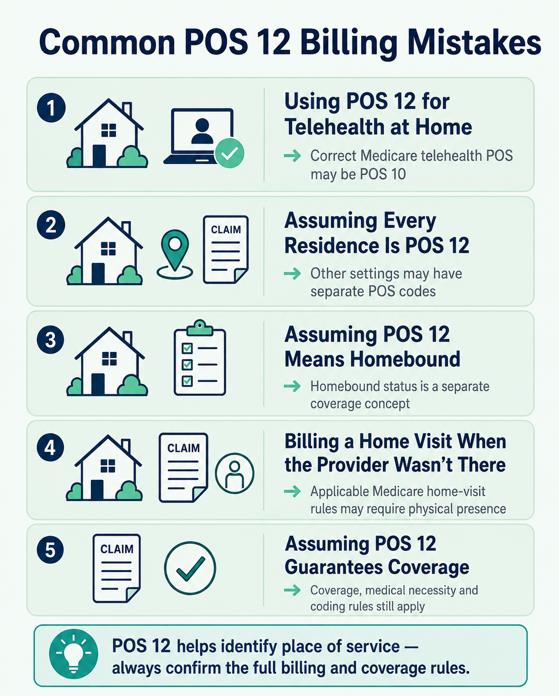
Using POS 12 for Telehealth at Home
This is one of the clearest mistakes.
For Medicare professional telehealth billing, a patient receiving telehealth while at home generally points to POS 10, not POS 12.
Assuming Every Residence Is POS 12
CMS has separate POS codes for settings such as:
- Assisted living facilities
- Group homes
- Temporary lodging
- Skilled nursing facilities
- Nursing facilities
Use the code that matches the actual setting.
Assuming POS 12 Means the Patient Is Homebound
POS 12 identifies location, not homebound status.
CMS explicitly distinguishes physician home services from the separate homebound requirements associated with the Medicare home health benefit.
Billing a Home Visit When the Provider Wasn’t There
For applicable Medicare physician home visits, the physician must actually be present in the beneficiary’s home.
A phone or video encounter should not be turned into an in-person POS 12 claim.
Assuming the POS Code Guarantees Coverage
A correct Place of Service code does not override:
- Coverage rules
- Medical necessity
- Coding requirements
- Provider eligibility
- Payer policy
Applying Medicare Rules to Every Insurance Plan
Private insurers, Medicare Advantage plans, and Medicaid programs may apply different reimbursement or documentation rules.
Always verify the payer.
POS 12 Billing Checklist
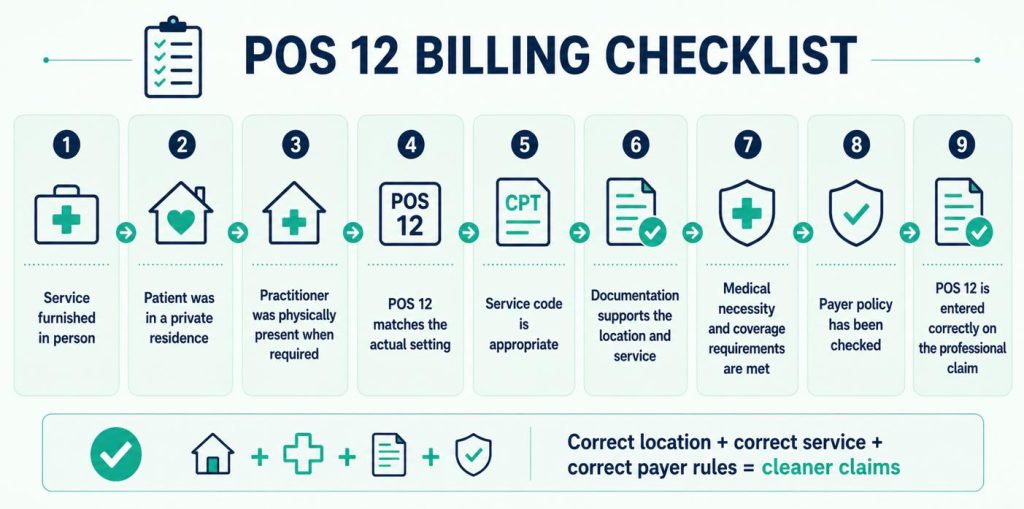
Before submitting a professional claim with POS 12, confirm:
- Was the service furnished in person?
- Was the patient in a private residence?
- Was the practitioner physically present when required?
- Is POS 12 more accurate than POS 10, 11, 13, 14, or 16?
- Is the service code appropriate for home-based care?
- Does documentation support the actual service location?
- Does the service meet medical-necessity and coverage requirements?
- Have you checked the payer’s current billing policy?
- Is POS 12 entered correctly on the professional claim?
Medical Billing and Patient Payment Processing Are Different
In this article, POS 12 means Place of Service 12. It should not be confused with a point-of-sale system used to collect patient payments.
A medical practice might use POS 12 on an insurance claim for an in-person home visit while separately using a payment platform to collect a patient’s financial responsibility.
Swyft POS provides payment-gateway technology that supports credit cards, debit cards, contactless payments, digital wallets, encrypted transaction processing, and integrated transaction reporting.
Keeping these workflows separate is important:
Medical billing determines how a healthcare claim is submitted. Patient payment processing determines how the practice collects eligible payments from patients.
Need a simpler way to manage patient payments? Explore Swyft POS payment solutions for flexible in-person and electronic payment processing.
Frequently Asked Questions About POS 12
What does POS 12 mean in medical billing?
POS 12 means Home. CMS defines it as a location other than a hospital or other facility where the patient receives care in a private residence.
Is POS 12 used for telehealth?
Generally, no, for Medicare professional telehealth received in the patient’s home. POS 10 identifies telehealth provided in the patient’s home, while POS 12 identifies the home as the location where an in-person service is furnished.
What is the difference between POS 10 and POS 12?
Both may involve a patient who is at home. POS 10 is for telehealth received at home, while POS 12 identifies an in-person service furnished in the patient’s private residence.
Does the provider have to be physically present for POS 12?
For applicable Medicare physician home-visit E/M services, yes. CMS states that the physician must actually be present in the beneficiary’s home to bill those home visit services with POS 12.
Does POS 12 mean the patient must be homebound?
No. CMS states that a beneficiary receiving applicable physician home services under POS 12 does not need to be confined to the home simply because the service is billed as a home visit. Homebound status is a separate requirement associated with certain Medicare benefits.
Is assisted living POS 12?
CMS maintains a separate POS 13 for Assisted Living Facility. Billers should use the POS code that accurately reflects the patient’s actual care setting.
Where do you enter POS 12 on a CMS-1500 claim?
Place of Service is entered in Item 24B on the CMS-1500 professional claim form. CMS identifies this as a required field.
Does POS 12 guarantee Medicare reimbursement?
No. POS 12 only identifies the service location. Coverage and payment also depend on the service, medical necessity, provider eligibility, coding, documentation, and other Medicare requirements.
Can commercial insurance use POS 12?
POS codes are used throughout the healthcare industry, but reimbursement policies can vary among Medicare, Medicaid, and private insurance plans. CMS recommends checking the individual payer’s policy.
Final Takeaway
POS 12 identifies an in-person healthcare service furnished in the patient’s private residence.
The easiest way to distinguish it from similar codes is to focus on where and how care was delivered.
If the healthcare professional physically provides an eligible service in the patient’s private residence, POS 12 may apply. If the patient is at home but receives the service through telehealth, Medicare professional billing generally points toward POS 10 instead.
Before submitting the claim, also confirm that the procedure code, provider, medical necessity, documentation, and payer-specific requirements support the service.
Key Takeaway: POS 12 = in-person care in the patient’s private residence. POS 10 = telehealth received in the patient’s home. The patient’s home alone does not make the two codes interchangeable.
This article is for general informational purposes only and is not legal, medical, reimbursement, or professional coding advice. Billing requirements can vary by service, provider, claim type, and payer. Verify current CMS, MAC, Medicaid, and commercial-payer guidance before submitting claims.