Taco Bell handles orders from front counters, drive-thrus, self-service kiosks, its mobile app, delivery channels, and other digital touchpoints. Keeping those transactions organized across thousands of restaurants requires much more than a basic cash register.
The Taco Bell POS system is part of a larger technology ecosystem designed to connect ordering, payments, restaurant operations, digital experiences, and franchise locations.
For years, Taco Bell’s proprietary point-of-sale platform was known as Poseidon. Yum! Brands confirmed in 2024 that Poseidon had been fully deployed across Taco Bell U.S. restaurants. In 2025, however, Yum! brought Poseidon and several other restaurant technologies under a unified platform called Byte by Yum!, while phasing out the older technology product names.
Understanding that transition is important when researching what POS system Taco Bell actually uses today.
What POS System Does Taco Bell Use?
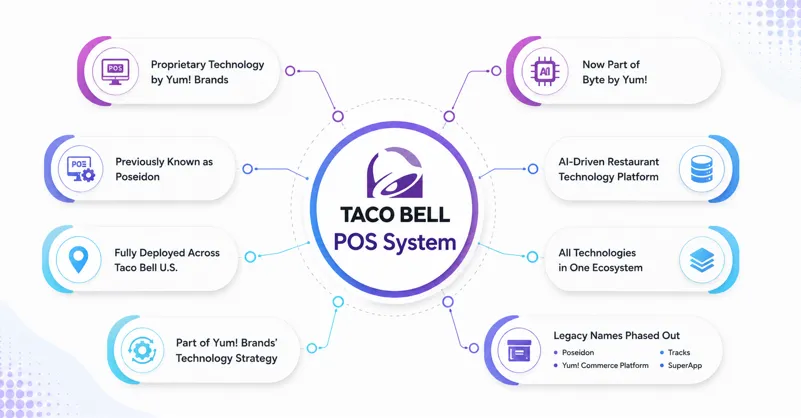
Taco Bell uses proprietary restaurant technology developed by its parent company, Yum! Brands.
The core POS technology was previously called Poseidon. Yum! stated in its second-quarter 2024 earnings call that Poseidon had been fully deployed throughout the Taco Bell U.S. system.
Poseidon was not simply a third-party POS product that individual Taco Bell franchisees selected independently. It was part of Yum!’s broader effort to develop proprietary restaurant technology across its brands.
That technology strategy changed in name and organization in 2025.
Yum! introduced Byte by Yum!, an AI-driven restaurant technology platform that brings several of its existing technologies into one ecosystem. The company specifically said it was phasing out legacy names, including:
- Poseidon
- Yum! Commerce Platform
- Tracks
- SuperApp
Those technologies are now housed under Byte by Yum!.
Therefore, it is more accurate today to describe Taco Bell’s POS as part of the Byte by Yum! restaurant technology ecosystem, while recognizing that many older sources and industry discussions still refer to the underlying POS technology as Poseidon.
What Is Byte by Yum!?
Byte by Yum! is a proprietary restaurant technology platform created by Yum! Brands for its restaurant brands and franchisees.
Instead of treating POS, online ordering, kitchen technology, inventory, and restaurant management as completely separate systems, Byte is designed to bring core restaurant technologies into a more connected environment.
Yum! says the platform includes technology for areas such as:
- Point of sale
- Online and mobile ordering
- Menu management
- Kitchen and delivery optimization
- Inventory management
- Labor management
- Team member tools
In the U.S., all four Yum! Brands were already using elements of Byte by Yum! when the platform was announced in 2025. Yum! also reported that its U.S. brands were processing more than 300 million digital transactions annually through elements of the platform.
For Taco Bell, this means the Taco Bell point-of-sale system should not be viewed as an isolated checkout application. It operates as one component of a much larger restaurant technology strategy.
How Does the Taco Bell POS System Work?
At its simplest, the POS records customer orders and helps complete transactions.
But a Taco Bell restaurant can receive orders from several places.
A customer might order:
- At the front counter
- Through a self-service kiosk
- At the drive-thru
- Through the Taco Bell app
- Through the Taco Bell website
- Through supported delivery services
The restaurant then needs to turn those different customer interactions into organized orders that employees can prepare and fulfill.
A simplified workflow looks like this:
Customer → Ordering Channel → POS/Order System → Payment → Kitchen → Fulfillment → Restaurant Data
The technology behind that workflow is increasingly interconnected.
For example, Taco Bell’s drive-thru ecosystem has combined digital menu boards, its proprietary POS technology, loyalty capabilities, and Voice AI.
That is why modern POS technology is better understood as the transaction layer connecting several restaurant systems rather than simply the screen used by a cashier.
Key Taco Bell POS System Features
The exact restaurant technology configuration can vary by location, market, and restaurant format. However, public Yum! And Taco Bell information reveals several important capabilities within the wider ecosystem.
Fast Order Entry and Customization
Taco Bell’s menu can create complicated POS requirements because customers frequently customize their orders.
A customer might remove an ingredient, substitute another item, add extra toppings, change sauces, or modify several products in one transaction.
The Taco Bell POS software therefore needs an efficient modification workflow that helps employees capture these changes accurately.
For a high-volume quick-service restaurant, every additional tap matters.
A well-designed POS interface can help reduce:
- Incorrect modifications
- Order-entry delays
- Employee confusion
- Remakes
- Checkout bottlenecks
This provides an important lesson for independent restaurants: POS usability can be just as important as the number of features included.
Payment Processing
Payment technology is another critical part of Taco Bell’s restaurant infrastructure.
Current franchise information indicates that designated payment hardware and processing services can be required for franchise locations. Publicly available franchise disclosure information identifies Verifone payment terminals for front-counter, drive-thru, and kiosk POS environments, along with Fiserv for credit card processing.
That demonstrates how the Taco Bell POS works alongside specialized payment infrastructure rather than performing every function itself.
For restaurant operators, this distinction matters because evaluating a POS should also include payment terminals, processing compatibility, security, and transaction costs.
Self-Service Kiosk Integration
Kiosks have become an important ordering channel for major quick-service restaurants.
Instead of an employee entering every front-counter transaction, customers can browse the menu, customize products, and submit orders through a digital interface.
The benefit is not simply replacing the cashier.
A connected kiosk strategy can help:
- Give customers more time to browse
- Display menu options visually
- Capture customizations
- Reduce pressure on front-counter staff
- Connect digital ordering with restaurant workflows
The POS and order-management environment needs to ensure that those kiosk orders reach the appropriate restaurant systems accurately.
Mobile and Online Ordering
The Taco Bell app and website create another major source of transactions.
Customers can browse menus, customize meals, access offers, use loyalty benefits, pay digitally, and select fulfillment options before arriving at the restaurant.
This changes what a restaurant POS needs to accomplish.
Instead of handling only orders entered by employees, the broader Taco Bell order management system must work within an ecosystem capable of coordinating orders initiated by customers across digital channels.
That makes consistent menu data, pricing, payment information, and order routing increasingly important.
Drive-Thru Technology
The drive-thru is one of the most interesting parts of Taco Bell’s technology strategy.
In 2024, Yum! announced plans to expand Voice AI technology to hundreds of Taco Bell U.S. drive-thrus. The company explained that the experience was supported by digital menu boards, its proprietary Poseidon POS technology, and Taco Bell Rewards capabilities.
Voice AI was designed to help automate parts of the ordering conversation.
The potential operational benefits include:
- Reducing repetitive employee tasks
- Improving order consistency
- Allowing employees to focus on other responsibilities
- Supporting a smoother drive-thru experience
- Creating additional digital customer interactions
Taco Bell and Yum! also incorporated franchisee feedback while developing the technology.
This highlights an important point: POS innovation increasingly happens around the POS, not just inside it.
Loyalty Integration
Modern POS systems also need to recognize customers, not just transactions.
Taco Bell Rewards creates a connection between ordering, customer accounts, promotions, and loyalty benefits.
When Yum! announced its Voice AI expansion, it specifically described the drive-thru ecosystem as connecting POS technology with the next generation of Taco Bell Rewards.
Connecting loyalty with ordering technology can make it easier to deliver personalized offers and maintain a consistent customer experience across channels.
Restaurant and Sales Data
Every transaction produces information.
At Taco Bell’s scale, restaurant technology can generate enormous amounts of data related to:
- Sales
- Orders
- Menu items
- Order channels
- Promotions
- Restaurant performance
- Customer behavior
- Operational trends
Yum!’s broader technology strategy increasingly uses digital data and AI to improve restaurant operations and customer experiences.
This makes reporting and analytics another essential part of the modern POS ecosystem.
Taco Bell POS System for Franchisees
Franchisees play an especially important role in Taco Bell’s technology strategy.
Unlike restaurant owners who can simply shop for a POS system and install their preferred product, Taco Bell franchisees operate within brand technology requirements.
Public franchise information indicates that Taco Bell requires specific restaurant technologies and service infrastructure. Its franchise support environment covers areas including POS, back-of-house systems, payment systems, kitchen display systems, kiosks, networking, mobile technology, and order confirmation boards.
This standardization has several potential benefits.
Franchise restaurants can operate with a more consistent technology foundation, while Taco Bell and Yum! can develop solutions that work across a large network.
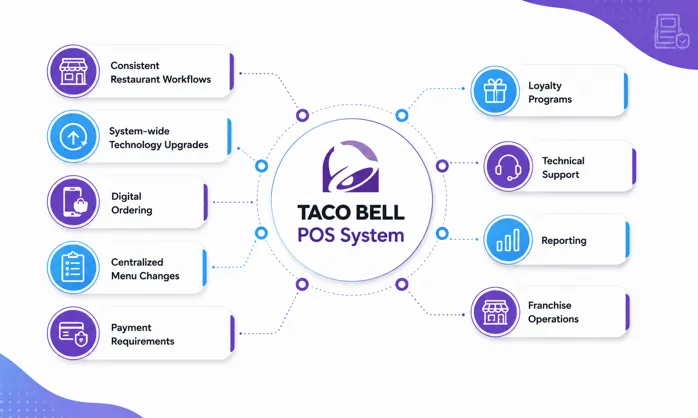
A standardized approach can support:
- Consistent restaurant workflows
- System-wide technology upgrades
- Digital ordering
- Centralized menu changes
- Payment requirements
- Loyalty programs
- Technical support
- Reporting
- Franchise operations
Taco Bell itself emphasizes restaurant technology as part of its franchise opportunity, describing the brand as continuing to push restaurant technology and new operating formats.
Is Poseidon Still the Taco Bell POS System?
Technically, Poseidon is now a legacy product name.
This distinction is important because many articles answering “What POS system does Taco Bell use?” may still simply answer “Poseidon.”
That answer has historical truth behind it. Yum! Confirmed Poseidon was fully deployed throughout Taco Bell U.S. in 2024.
But Yum! reorganized its restaurant technology portfolio in 2025.
Poseidon and other technology products were brought under Byte by Yum!, with Yum! explicitly stating that the legacy names and branding were being phased out.
A more accurate current answer is:
Taco Bell’s proprietary POS technology evolved from the Poseidon platform and is now part of the broader Byte by Yum! restaurant technology ecosystem.
This distinction makes the information more useful for readers researching Taco Bell’s current technology rather than relying on outdated vendor lists.
Taco Bell POS vs. a Typical Independent Restaurant POS
| Area | Taco Bell Technology | Typical Independent POS |
|---|---|---|
| POS approach | Proprietary Yum! ecosystem | Commercial POS provider |
| Technology platform | Byte by Yum! | Vendor-specific software |
| Restaurant scale | Thousands of locations | Usually one or several |
| Franchise requirements | Brand-controlled standards | The owner chooses the system |
| Kiosk integration | Major ordering channel | Optional |
| Mobile ordering | Connected brand ecosystem | POS integration or third-party |
| Loyalty | Taco Bell Rewards ecosystem | POS or third-party program |
| Drive-thru technology | POS, digital boards and AI | Varies significantly |
| Payments | Designated infrastructure | Merchant often chooses |
| Technology development | Parent-company technology platform | POS vendor develops software |
Neither approach is automatically better.
Taco Bell requires enterprise technology capable of supporting thousands of restaurants and franchisees. A local taco shop may prioritize affordability, simplicity, flexibility, and easy integrations instead.
What Restaurants Can Learn From Taco Bell’s POS Strategy
You do not need thousands of locations to apply the same principles.
Independent restaurants and smaller chains can use Taco Bell’s technology strategy as a checklist when evaluating restaurant POS software.
Connect Every Ordering Channel
Customers should not create completely separate operational workflows depending on where they order.
When possible, connect counter, kiosk, online, mobile, delivery, and drive-thru orders into an organized restaurant workflow.
Make Customization Easy
If your menu allows modifications, test how many steps employees need to enter them.
A POS that makes customization difficult can create slower service and more mistakes during busy periods.
Think Beyond the Register
Taco Bell’s strategy shows that the POS is only one part of restaurant technology.
Consider how your system connects with payments, kitchen displays, online ordering, loyalty, inventory, reporting, and employee tools.
Prioritize Employee Experience
Technology should remove unnecessary work rather than create more of it.
Yum! has described its Voice AI strategy partly in terms of reducing team-member workload so employees can focus more attention on customers.
The same principle applies to smaller restaurants.
Choose Technology That Can Evolve
Restaurant ordering behavior changes quickly.
A POS that works perfectly for one counter today may need to support kiosks, mobile orders, new payment methods, loyalty, or additional locations tomorrow.
Scalability should therefore be considered before those needs become urgent.
Common Mistakes When Comparing Your POS With Taco Bell
Copying an enterprise restaurant’s technology stack feature-for-feature is rarely a good strategy for an independent business.
Common mistakes include:
- Paying for features employees will never use
- Focusing only on POS hardware
- Ignoring payment processing requirements
- Adding online ordering without planning kitchen capacity
- Choosing integrations without testing reliability
- Overcomplicating employee workflows
- Ignoring technical support and downtime procedures
- Selecting a system that cannot scale to additional locations
The better approach is to identify the operating principles behind Taco Bell’s technology and apply only the ones relevant to your restaurant.
FAQs About the Taco Bell POS System
What POS system does Taco Bell use?
Taco Bell U.S. previously identified its proprietary POS platform as Poseidon. Yum! Brands confirmed that Poseidon was fully deployed across Taco Bell U.S. by 2024. In 2025, Yum! Moved Poseidon and other proprietary restaurant technologies under its unified Byte by Yum! platform and began phasing out the older product names.
What is Byte by Yum!?
Byte by Yum! is Yum! Brands’ proprietary restaurant technology platform. It brings technologies for POS, online ordering, menu management, kitchen and delivery optimization, inventory, labor management, and team-member tools into a broader integrated ecosystem.
Does Taco Bell use Poseidon POS?
Yes, Poseidon was the name of Yum!’s proprietary POS platform deployed throughout Taco Bell U.S. However, Poseidon is now a legacy product name because Yum! consolidated it under Byte by Yum! in 2025.
Does Taco Bell use AI for drive-thru orders?
Yes. Taco Bell and Yum! have deployed Voice AI technology in U.S. drive-thrus. The system works within a broader drive-thru technology ecosystem that includes digital menu boards, POS technology, and loyalty capabilities.
Can Taco Bell franchisees choose any POS system?
Taco Bell franchisees operate under brand technology standards rather than simply selecting any consumer POS product independently. Taco Bell’s franchise technology environment includes specified systems and support covering POS, payments, kitchen displays, kiosks, networks, mobile technology, and other restaurant systems.
Conclusion
The Taco Bell POS system is a good example of how point-of-sale technology is becoming part of a much larger restaurant operating platform.
Taco Bell U.S. moved to Yum!’s proprietary Poseidon POS system, but the technology has continued to evolve. Since 2025, Poseidon has been incorporated into Byte by Yum!, which connects POS capabilities with a broader ecosystem covering digital ordering, restaurant operations, inventory, kitchen technology, employee tools, and other functions.
For restaurant owners, the most useful lesson is not to recreate Taco Bell’s enterprise technology stack. Instead, focus on the principles behind it: fast order entry, simple customization, connected ordering channels, reliable payments, useful integrations, employee-friendly workflows, and technology that can grow with the business.
If you’re choosing a POS for your restaurant, evaluate the entire operating ecosystem—not just the terminal at the checkout counter.