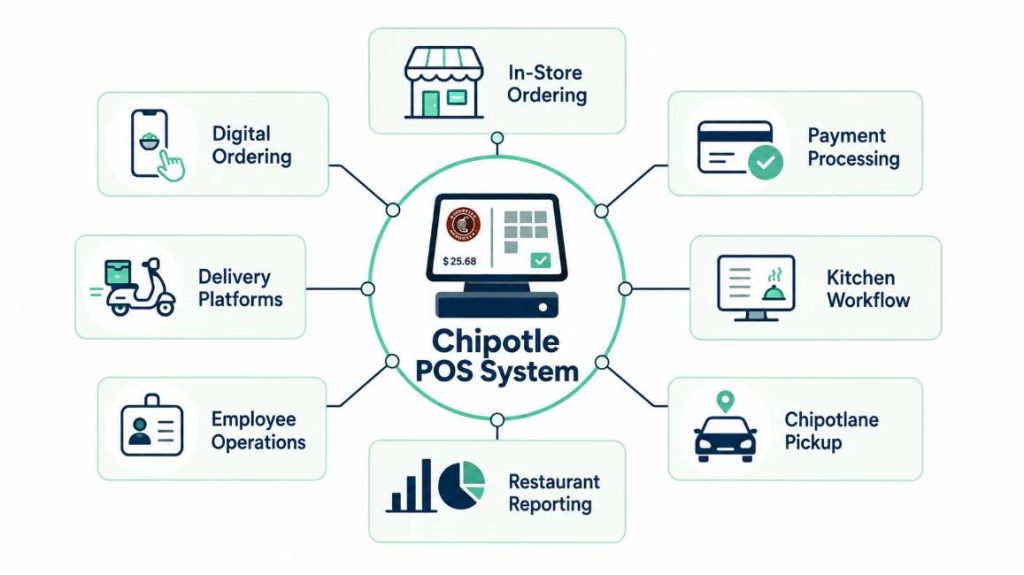
Chipotle serves customers across restaurant counters, its website and mobile app, third-party delivery services, and digital pickup lanes. Keeping all those orders organized requires more than a traditional cash register.
The Chipotle POS system sits at the center of this restaurant technology environment. It helps process in-store transactions while connecting with payment processing, digital ordering, restaurant reporting, and other operational systems.
Chipotle is also entering an important new phase in its POS strategy. NCR Voyix announced in November 2025 that Chipotle will become the first restaurant brand to implement its next-generation Aloha POS technology across roughly 4,000 restaurants worldwide under a new six-year agreement.
Understanding that transition provides a useful look at how one of the world’s largest fast-casual restaurant brands approaches point-of-sale technology.
What POS System Does Chipotle Use?
Chipotle has a long-standing relationship with NCR Voyix and its Aloha point-of-sale technology.
In November 2025, NCR Voyix announced that it had signed a new six-year exclusive agreement with Chipotle, extending a relationship that the technology provider says spans more than 25 years. Under the agreement, Chipotle is set to become the first customer to implement Aloha Next, NCR Voyix’s next-generation POS and supporting applications, across approximately 4,000 restaurants worldwide.
Aloha Next is built on the Voyix Commerce Platform and uses a dual-cloud, edge-enabled microservices architecture.
However, there is an important distinction.
The announcement does not mean every Chipotle restaurant instantly switched to Aloha Next in 2025. NCR Voyix reported in February 2026 that the system was in Chipotle’s lab and that the rollout remained on schedule as both companies worked through readiness milestones.
So, when discussing the current Chipotle POS, it is more accurate to describe an established NCR/Aloha relationship that is now moving toward NCR Voyix’s next-generation Aloha platform.
How Does the Chipotle POS System Work?
At the restaurant level, the POS helps employees record orders, complete transactions, process payments, and generate sales information.
Chipotle has historically described its restaurant technology structure as being based primarily on a local POS system integrated with other restaurant functions. Earlier company filings explained that the system recorded sales transactions, received orders placed outside the restaurant, handled credit card transaction processes, captured employee time-clock information, and produced management reports.
Today’s operating environment is even more complex because customers can order through multiple channels.
A simplified order flow can look like this:
Customer order → ordering channel → POS/order management → payment → kitchen workflow → pickup or fulfillment → transaction data
The ordering channel might be:
- Front counter
- Chipotle website
- Chipotle mobile app
- Third-party delivery platform
- Digital pickup order
- Chipotlane
The goal is to move orders from different sources into restaurant operations without creating unnecessary complexity for employees.
Key Chipotle POS System Features
The Chipotle POS technology should be understood as part of a larger restaurant technology stack rather than as one isolated checkout terminal.
Several capabilities are particularly important to Chipotle’s operating model.
Fast In-Store Order Processing
Chipotle’s service model depends on speed.
Customers move through an assembly line while choosing ingredients for burritos, bowls, tacos, salads, and other menu items. The POS needs to allow employees to accurately record the transaction without creating a bottleneck at checkout.
Unlike a restaurant where the server enters an entire customized meal before it is prepared, much of Chipotle’s customization happens visually along the service line.
That makes a fast and straightforward checkout workflow especially important.
Payment Processing
Payment processing is another fundamental part of the Chipotle point-of-sale system.
Chipotle’s public filings identify POS and payment processing systems as important technologies used throughout restaurant operations. These systems need to support secure, reliable transactions while communicating with other parts of the restaurant’s technology infrastructure.
The company has also emphasized cybersecurity risks associated with its POS, web and mobile platforms, online and mobile payments, delivery systems, and rewards program, demonstrating how interconnected modern restaurant payment technology has become.
Digital Order Integration
Digital ordering is one of the biggest reasons modern restaurant POS technology needs to extend beyond the counter.
Chipotle defines digital sales as food and beverage revenue generated through its website, mobile app, and third-party delivery aggregators. In the first quarter of 2026, digital sales accounted for 38.6% of total food and beverage revenue.
That represents a substantial amount of restaurant activity happening away from the traditional register.
A connected Chipotle order management system therefore needs to help restaurants coordinate orders arriving from both physical and digital channels.
Chipotlane Support
Chipotlanes add another important component to Chipotle’s technology strategy.
Unlike a traditional drive-thru where customers typically place an order through a speaker, a Chipotlane is designed primarily around digitally placed orders that customers pick up from a dedicated lane.
The format has become increasingly important to Chipotle’s expansion strategy. During the first quarter of 2026, 42 of the company’s 49 newly opened company-owned restaurants included a Chipotlane. Chipotle says the format helps improve convenience and supports new restaurant sales, margins, and returns.
This illustrates an important point: restaurant POS and ordering technology can influence physical restaurant design, not just checkout.
Restaurant Reporting
Every POS transaction creates data.
A large restaurant operator can use that information to better understand:
- Restaurant sales
- Transaction volume
- Average checks
- Product performance
- Digital versus in-store demand
- Restaurant-level trends
- Operational performance
Chipotle has historically described its POS environment as producing management reports and collecting selected restaurant information into centralized systems.
For a company operating thousands of restaurants, centralized visibility becomes critical because individual transactions eventually contribute to broader decisions about operations, menu strategy, staffing, and growth.
Employee and Operational Functions
POS technology can also connect with operational functions that customers never see.
Chipotle’s historical disclosures noted that its restaurant POS infrastructure could capture employee time-clock information in addition to sales transactions.
More broadly, Chipotle relies on technology for restaurant operations, supply chain management, scheduling, training, financial tools, digital ordering, rewards, and other business processes.
The POS should therefore be viewed as one component of a much larger restaurant technology ecosystem.
Chipotle’s Move to Aloha Next
One of the most significant developments in the Chipotle POS system is its planned transition to NCR Voyix’s Aloha Next.
NCR Voyix announced the agreement in November 2025, describing Chipotle as the first restaurant company that will implement the next-generation platform. The six-year global agreement expands a technology relationship spanning more than two decades.
Aloha Next is built on the Voyix Commerce Platform using a dual-cloud, edge-enabled microservices architecture.
Those terms can sound overly technical, but the underlying strategy is easier to understand.
Instead of building restaurant technology as one large, difficult-to-change application, a microservices approach can separate functionality into smaller services. This can make it easier to develop, update, and integrate different capabilities over time.
The edge component is also relevant for restaurants because certain technology processes can operate closer to the restaurant instead of depending entirely on a distant cloud service.
As of NCR Voyix’s February 2026 earnings update, Aloha Next was in Chipotle’s lab and the companies remained aligned on deployment-readiness milestones.
Therefore, it is best described as Chipotle’s next-generation POS direction, rather than a completed chain-wide deployment.
How Digital Ordering Changes Chipotle’s POS Strategy
Traditional restaurant POS systems were built around a simple assumption: the customer enters the restaurant, places an order, and pays at a register.
Chipotle’s business no longer works that way.
Customers can place orders before arriving, use the Chipotle app, order from the website, use delivery marketplaces, or collect orders through a Chipotlane.
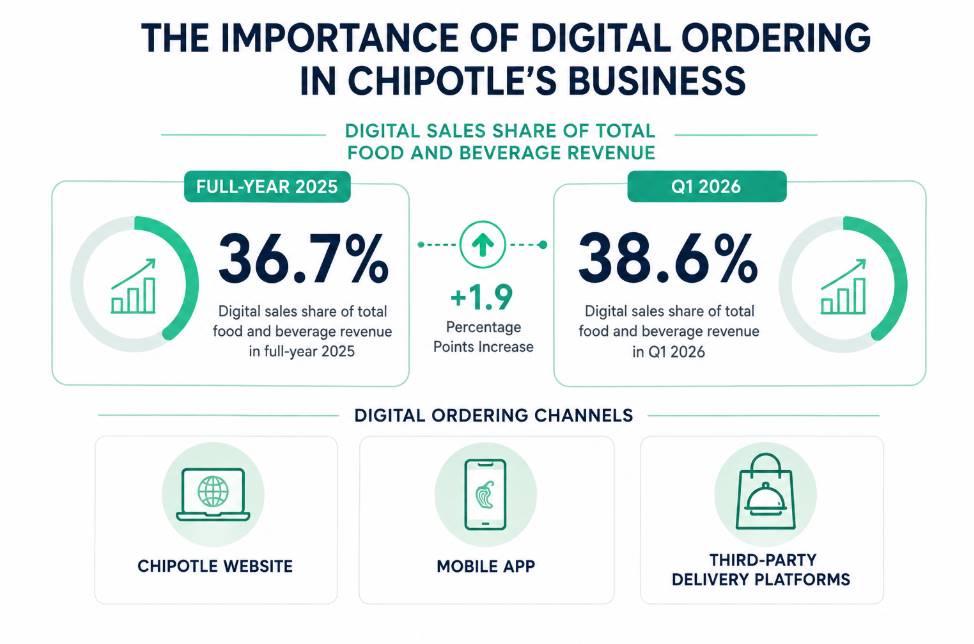
Digital sales represented 36.7% of Chipotle’s total food and beverage revenue for full-year 2025 and 38.6% in the first quarter of 2026.
This means digital ordering is not an optional side channel.
It is a major part of the restaurant operation.
Modern Chipotle POS software therefore needs to coexist with an ecosystem capable of coordinating menus, orders, payments, fulfillment, customer data, and restaurant reporting across multiple channels.
Does Chipotle Franchise Its Restaurants?
This is an important clarification because people searching for a Chipotle POS system for franchisees may assume Chipotle operates like many other major restaurant chains.
Historically, Chipotle has primarily owned and operated its restaurants rather than using a traditional domestic franchise model.
As of the end of 2025, Chipotle owned 4,042 restaurants, including 3,938 in the United States and 104 international locations. It also had 14 international partner-operated restaurants.
Chipotle has expanded its partner-operated model internationally. The company began that strategy with Alshaya Group in the Middle East, which Chipotle described in 2023 as its first franchise partner.
By 2026, Chipotle’s reporting uses the broader term partner-operated restaurants, which can include locations operated under franchise or license agreements or other structures where Chipotle does not control day-to-day operations.
So, unlike brands built around thousands of independent U.S. franchisees, Chipotle maintains much greater centralized control over its primary restaurant network.
That structure can also make technology standardization easier across company-operated locations.
Chipotle POS vs. a Typical Independent Restaurant POS
| Area | Chipotle’s Approach | Typical Independent Restaurant |
|---|---|---|
| POS platform | Enterprise NCR/Aloha relationship | Owner chooses provider |
| Scale | Thousands of restaurants | Usually, one or several locations |
| Digital ordering | Major sales channel | Depends on restaurant |
| Drive-thru strategy | Chipotlane digital pickup | Traditional drive-thru or none |
| Technology management | Highly standardized | Owner-managed |
| Reporting | Enterprise-wide requirements | Store or multi-location reporting |
| Integrations | Large restaurant ecosystem | Depends on the POS provider |
| POS development | Moving toward Aloha Next | Usually, the vendor’s standard platform |
The biggest difference is scale.
An independent restaurant does not need technology built for more than 4,000 locations. However, the operating principles behind Chipotle’s strategy can still be valuable.
What Restaurants Can Learn From Chipotle’s POS Strategy
You do not need thousands of locations to apply the same principles.
Independent restaurants and smaller chains can use Chipotle’s technology strategy as a checklist when evaluating restaurant POS software.
Connect Digital and In-Store Ordering
Online ordering should not create a completely separate operational burden.
Look for a POS ecosystem that can coordinate in-store, online, delivery, and mobile transactions as efficiently as possible.
Design Technology Around Customer Behavior
Chipotlanes are a strong example.
Instead of simply adding technology to an existing drive-thru model, Chipotle created a pickup experience around customers who had already ordered digitally.
Restaurants should think about how technology can improve the entire customer journey rather than just the payment step.
Prioritize Reliability
POS downtime can affect orders, payments, reporting, and customer experience simultaneously.
Reliability, offline capabilities, network infrastructure, support, and recovery procedures should therefore be evaluated alongside flashy POS features.
Make Integrations a Priority
A restaurant POS rarely operates alone.
Before choosing a system, consider how it connects with:
- Online ordering
- Payment processing
- Kitchen technology
- Loyalty programs
- Delivery platforms
- Inventory tools
- Employee management
- Accounting software
- Restaurant analytics
The best POS is often the one that works well with the rest of your technology.
Plan for Future Growth
Chipotle’s move toward a microservices-based platform highlights another lesson: restaurant technology needs to evolve.
Independent operators should consider whether a POS can support additional locations, ordering channels, integrations, and new customer experiences without requiring a complete replacement.
Common Mistakes When Comparing Your POS With Chipotle
Restaurant owners should avoid copying an enterprise technology strategy without considering their own needs.
A few common mistakes include:
- Buying more technology than the restaurant actually needs
- Focusing on hardware instead of software and integrations
- Ignoring digital ordering workflows
- Choosing a POS without evaluating support
- Overlooking payment processing costs
- Failing to test employee usability
- Ignoring reporting and multi-location capabilities
- Assuming a large restaurant chain uses one piece of software for every operational function
Chipotle’s technology environment is built for enormous scale. A smaller restaurant should adopt the useful principles without unnecessarily recreating the complexity.
FAQs About the Chipotle POS System
What POS system does Chipotle use?
Chipotle has a long-standing relationship with NCR Voyix and Aloha POS technology. In November 2025, NCR Voyix announced a six-year agreement under which Chipotle will become the first customer to implement Aloha Next and supporting applications across approximately 4,000 restaurants worldwide.
Is Chipotle already using Aloha Next everywhere?
No. NCR Voyix reported in February 2026 that Aloha Next was in Chipotle’s lab and that the rollout remained on schedule. That indicates the next-generation platform was still moving through testing and readiness milestones rather than already operating chain-wide.
Does the Chipotle POS handle online orders?
Chipotle’s restaurant technology environment supports a substantial digital business involving orders through the Chipotle website, mobile app, and third-party delivery aggregators. Digital sales represented 38.6% of food and beverage revenue during Q1 2026.
What is a Chipotlane?
A Chipotlane is Chipotle’s digital-order pickup lane. Customers typically place their order before arriving and then collect it through the dedicated lane, helping connect mobile ordering with convenient restaurant pickup.
Can Chipotle franchisees choose their own POS?
This question mostly applies to Chipotle’s international partner-operated restaurants because Chipotle owns and operates its primary restaurant network in North America and Europe. Its international expansion increasingly includes partner-operated locations under licensing, franchise, and other partnership structures.
Conclusion
The Chipotle POS system demonstrates how point-of-sale technology has evolved from a checkout tool into part of a much broader restaurant technology ecosystem.
Chipotle’s long relationship with NCR Voyix, significant digital sales, Chipotlane strategy, and planned transition to Aloha Next show the importance of connecting in-store transactions with digital ordering, payments, restaurant data, and scalable technology infrastructure.
For independent restaurants, the goal should not be to copy Chipotle’s enterprise setup. Instead, apply the underlying principles: choose a POS that is fast for employees, reliable during busy periods, connected to your digital ordering channels, compatible with important integrations, and capable of growing with your business.
If you’re evaluating a restaurant POS system, compare the entire technology ecosystem, not just the screen sitting next to the register.