A patient walks into a medical office, checks in, sees the practitioner, and receives treatment before going home. That may sound like the simplest billing scenario possible, but the claim still needs to tell the payer where the service happened.
That is where POS 11 comes in.
Place of Service Code 11 means “Office.” It is commonly used on professional claims when a healthcare professional provides examinations, diagnosis, or treatment in a qualifying office setting on an ambulatory basis.
The important part is that POS 11 describes the actual place of service. A location does not become POS 11 simply because patients casually call it a “doctor’s office” or “clinic.”
POS 11 at a Glance
| Item | POS 11 Details |
|---|---|
| Code | 11 |
| Official name | Office |
| Type of setting | Ambulatory office setting |
| Typical care | Exams, diagnosis, treatment and other eligible office-based services |
| Medicare PFS category | Generally non-facility for applicable services |
| CMS-1500 field | Item 24B |
| Telehealth at patient’s home? | No — Medicare professional telehealth rules generally point to POS 10 |
| Hospital outpatient department? | No — POS 19 or POS 22 may apply |
| Independent clinic automatically POS 11? | No — POS 49 may apply |
What Does POS 11 Mean in Medical Billing?
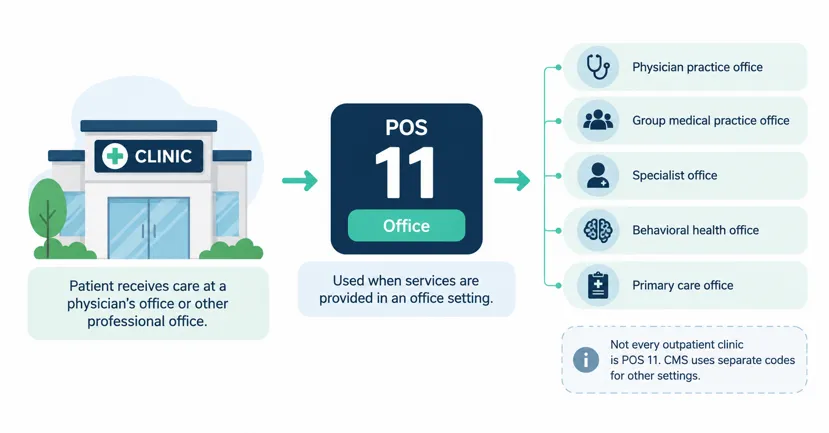
CMS defines POS 11 as Office: a location other than specified institutional settings where a health professional routinely provides health examinations, diagnosis, and treatment of illness or injury on an ambulatory basis.
In simpler terms, think of a traditional professional office where patients come for outpatient care and leave after the visit.
Common examples can include a qualifying:
- Physician practice office
- Group medical practice office
- Specialist office
- Behavioral health office
- Primary care office
- Other professional office that meets the CMS POS 11 definition
But there is an important warning:
Not every outpatient clinic is POS 11.
CMS maintains separate codes for independent clinics, hospital outpatient departments, urgent care facilities, federally qualified health centers, rural health clinics, and other settings.
That makes the actual status of the location more important than what appears on the sign outside.
Has the Meaning of POS 11 Changed in 2026?
No major new definition of POS 11 was introduced for 2026.
CMS’s current Place of Service code set, available on its page updated in February 2026, continues to define POS 11 as Office.
For billing teams, the bigger issue in 2026 is therefore not learning a new POS 11 definition. It is making sure POS 11 is not being used for settings that now have their own specific POS codes, such as Independent Clinic POS 49.
When Is POS 11 the Right Code?
Instead of starting with the procedure code, start with the location.
Ask:
Where did the patient actually receive the face-to-face service?
For services paid under the Medicare Physician Fee Schedule, CMS instructs providers to use the POS code assigned to the setting where the patient received the face-to-face service. CMS specifically gives an office encounter as an example where POS 11 generally reflects the correct setting.
POS 11 may therefore be appropriate when:
- The patient comes to a qualifying professional office
- Care is delivered on an outpatient basis
- The professional routinely provides examination, diagnosis, or treatment there
- The location is not more accurately described by another POS code
- The service itself meets applicable coding and coverage requirements
Example: Routine Office Follow-Up
A patient visits a physician’s established office for an in-person follow-up appointment.
Likely POS: 11
Example: Specialist Consultation
A patient visits a qualifying cardiology practice office for an ambulatory consultation and evaluation.
Likely POS: 11, assuming the setting meets the Office definition and another POS code does not more accurately describe it.
Example: Minor Office Procedure
A practitioner performs an eligible minor procedure in the practitioner’s professional office.
POS 11 may apply, subject to the service, payer, and coding requirements.
The Location Looks Like an Office. Is POS 11 Always Correct?
No—and this is where many POS 11 explanations become too simplistic.
Imagine two medical suites that look almost identical to a patient. Both have an exam room, reception desk, and physician.
One may qualify as a physician office.
The other may be a hospital provider-based outpatient department.
They can require different POS codes even though the patient experience looks similar.
The best billing question is not:
“Does this look like an office?”
It is:
“What is the actual billing and facility status of this service location?”
POS 11 vs POS 22: Office or Hospital Outpatient?
One of the most important comparisons is POS 11 vs POS 22.
| Factor | POS 11 | POS 22 |
|---|---|---|
| Name | Office | On Campus-Outpatient Hospital |
| Setting | Professional office | Hospital outpatient department on main campus |
| Patient status | Ambulatory | Hospital outpatient |
| Medicare PFS treatment | Generally non-facility | Facility setting |
| Separate facility payment may exist | Generally no separate institutional facility payment for the office | Hospital may receive separate payment under applicable rules |
CMS defines POS 22 as a portion of a hospital’s main campus that provides diagnostic, therapeutic, or rehabilitation services to people who do not require hospitalization.
This difference matters because Medicare’s Physician Fee Schedule distinguishes between facility and non-facility practice expenses.
For most services performed in an office, Medicare’s non-facility payment reflects resources such as clinical staff, supplies, and equipment that the practitioner or practice may incur. In a facility setting, part of those costs may instead be borne and paid to the facility.
That is why reporting the correct site of service matters for reimbursement.
POS 11 vs POS 19
POS 19 means Off-Campus Outpatient Hospital.
CMS defines it as an off-campus hospital provider-based department that furnishes outpatient diagnostic, therapeutic, or rehabilitation services.
So the basic distinction is:
- POS 11: qualifying professional office
- POS 19: off-campus hospital outpatient department
- POS 22: on-campus hospital outpatient department
A medical building being physically located away from a hospital does not automatically make it POS 11.
Provider-based status matters.
POS 11 vs POS 49: A Particularly Important Distinction
This comparison deserves special attention because POS 49 is relatively new compared with POS 11.
CMS defines POS 49 as Independent Clinic: a location that is not part of a hospital, is not described by another POS code, and is organized to provide preventive, diagnostic, therapeutic, rehabilitative, or palliative services to outpatients only. POS 49 became effective October 1, 2023.
This means the statement:
“Every standalone independent clinic uses POS 11”
is not accurate.
A physician’s private office may still qualify for POS 11. But a location that meets CMS’s specific Independent Clinic definition may require POS 49.
If there is uncertainty, CMS recommends taking billing questions to the relevant payer or, for Medicare, the appropriate Medicare Administrative Contractor (MAC).
POS 11 vs POS 20: What About Urgent Care?
POS 20 is specifically designated for an Urgent Care Facility.
CMS describes it as a location distinct from a hospital emergency room, office, or clinic whose purpose is to diagnose and treat unscheduled ambulatory patients seeking immediate attention.
So an urgent care center should not simply use POS 11 because physicians work there.
The nature of the setting determines the POS.
Other Office-Like Settings That Have Their Own Codes
Medical billers should also watch for locations such as:
- POS 50 — Federally Qualified Health Center
- POS 71 — Public Health Clinic
- POS 72 — Rural Health Clinic
- POS 81 — Independent Laboratory
CMS assigns distinct codes to these settings.
This leads to a useful billing rule:
Use the most accurate POS code for the actual setting instead of defaulting to POS 11 whenever care is outpatient.
Can POS 11 Be Used for Telehealth?
Do not use POS 11 simply because the provider is sitting in an office during a telehealth encounter.
For current Medicare professional telehealth billing, patient location is reported using the applicable telehealth POS rules:
- POS 10 when the patient receives qualifying telehealth in their home
- POS 02 when the patient receives qualifying telehealth somewhere other than their home
CMS separately defines POS 11 as the physical Office setting.
For example, if a physician sits in their office while conducting an eligible Medicare telehealth appointment with a patient who is at home, the provider’s office location alone does not turn the encounter into POS 11.
Always verify current payer-specific telehealth instructions because commercial insurers, Medicaid, and Medicare Advantage requirements may differ.
How POS 11 Can Affect Medicare Payment
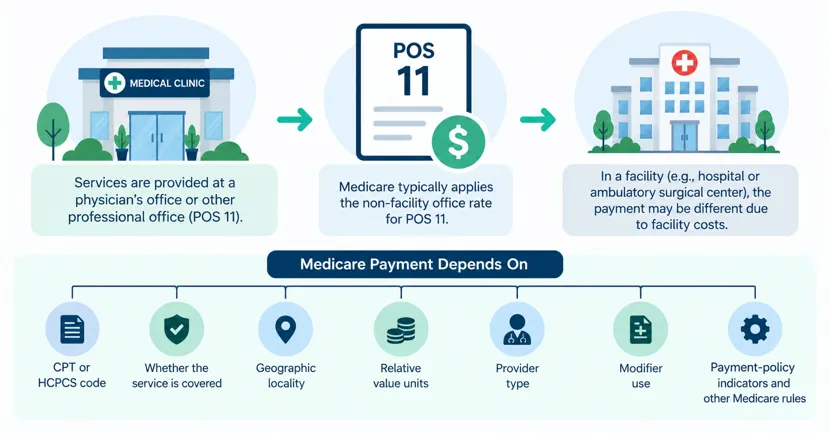
POS 11 is generally treated as a non-facility office setting for applicable Medicare Physician Fee Schedule services.
CMS’s PFS guidance explains that the non-facility price applies to procedures performed in settings such as an office. The payment may account for resources the practice bears directly, including staff, supplies, and equipment.
In a facility such as a hospital or ambulatory surgical center, the practitioner’s PFS amount may be different because the facility incurs some of those operating expenses and may receive separate payment.
However:
POS 11 does not guarantee that a service will always be paid more.
Actual Medicare reimbursement depends on factors such as:
- CPT or HCPCS code
- Whether the service is covered
- Geographic locality
- Relative value units
- Provider type
- Modifier use
- Payment-policy indicators
- Other Medicare rules
Use the Medicare Physician Fee Schedule tools for service-specific payment information rather than assuming one universal POS 11 reimbursement rate.
Where Is POS 11 Entered on a Claim?
On the CMS-1500 professional claim form, Place of Service is entered in Item 24B.
CMS identifies this as a required field and tells providers to enter the appropriate POS code for the setting of each service or item.
For electronic professional claims, the corresponding POS information is reported through the relevant 837P claim fields.
The service-location information should also accurately reflect where the care was furnished.
A Practical POS 11 Claim Check
Before submitting POS 11, run through these questions.
1. Was the Service Face-to-Face in an Office?
Verify that this was an in-person office service rather than telehealth, home care, hospital outpatient care, or another setting.
2. Does the Location Meet the CMS Office Definition?
Do not rely on the business name alone.
Confirm the actual status of the practice location.
3. Is Another POS More Specific?
Check whether the setting is more accurately described as:
- POS 19
- POS 20
- POS 22
- POS 49
- POS 50
- POS 71
- POS 72
- another applicable code
4. Does the Service Code Fit the Setting?
Correct POS coding does not make an otherwise unsupported CPT or HCPCS code payable.
5. Does the Payer Follow the Same Rules?
CMS specifically advises providers to check individual payer reimbursement policies for POS codes.
6. Is the POS Entered Correctly?
For a CMS-1500 claim, verify Item 24B before submission.
Common POS 11 Billing Mistakes
Treating Every Clinic as POS 11
This is probably the biggest misconception.
CMS now has a separate POS 49 for Independent Clinic, along with other codes for FQHCs, RHCs, urgent care facilities, and hospital outpatient departments.
Using POS 11 for a Hospital Outpatient Department
A service may occur in a room that looks like a doctor’s office but still be part of a hospital provider-based department.
POS 19 or POS 22 may be more appropriate.
Choosing POS Based on the Provider’s Main Office
The relevant location is generally the setting where the patient received the face-to-face service—not simply the provider’s normal practice address.
Assuming POS 11 Automatically Pays a Higher Rate
While office services commonly use the Medicare non-facility payment amount, actual reimbursement is code-specific.
Do not calculate expected payment based on POS alone.
Using POS 11 for Telehealth Because the Provider Is in the Office
For Medicare professional telehealth billing, the appropriate telehealth POS depends on the applicable rules and patient location. See also POS 12 for another medical billing Place of Service code.
Ignoring Payer-Specific Requirements
Medicare, Medicaid, Medicare Advantage, and commercial plans can have different reimbursement policies.
CMS explicitly advises checking with individual payers.
POS 11 Billing Checklist
Before you submit an office claim, confirm:
- ✓ The patient received the service in person
- ✓ The location qualifies as an Office under POS 11
- ✓ The setting is not a hospital outpatient department
- ✓ The setting is not better described by POS 20, 49, 50, 71, 72, or another code
- ✓ The CPT or HCPCS code is appropriate
- ✓ Documentation supports the service
- ✓ The service location is reported correctly
- ✓ POS 11 is entered correctly in Item 24B when using CMS-1500
- ✓ Medical necessity and coverage requirements are met
- ✓ The payer’s current POS policy has been checked
Medical POS Coding and Patient Payments Serve Different Purposes
In this article, POS 11 means Place of Service Code 11. It is a medical billing code used to communicate where professional healthcare services were furnished.
A point-of-sale system has a different job.
A medical office may bill an insurer using POS 11 while separately collecting a patient’s copay, deductible, balance, or other eligible patient responsibility through its payment system.
Swyft POS provides integrated payment-gateway technology supporting card payments, contactless payments, digital wallets, encrypted payment processing, transaction reporting, and payment reconciliation.
Keeping those two functions clear helps avoid confusion:
POS 11 tells the payer where medical care occurred. A point-of-sale platform helps the practice process patient payments.
Looking to simplify in-office patient payments? Explore Swyft POS payment solutions for flexible electronic payment processing.
Frequently Asked Questions About POS 11
What does POS 11 mean in medical billing?
POS 11 means Office. CMS uses it for a qualifying location where health professionals routinely provide examinations, diagnosis, and treatment of illness or injury on an ambulatory basis.
Is POS 11 a facility or non-facility setting?
For applicable Medicare Physician Fee Schedule services, a typical office setting is generally treated as non-facility. Medicare’s non-facility payment can include practice expenses associated with providing staff, supplies, and equipment.
Is every doctor’s clinic POS 11?
No. A clinic may be an independent clinic, hospital outpatient department, FQHC, RHC, urgent care facility, or another setting with its own POS code. The actual status of the location determines the appropriate code.
What is the difference between POS 11 and POS 22?
POS 11 identifies an Office, while POS 22 identifies an on-campus hospital outpatient department. The distinction can also affect Medicare Physician Fee Schedule payment because one is generally non-facility and the other is a facility setting.
What is the difference between POS 11 and POS 49?
POS 11 means Office. POS 49 means Independent Clinic and applies to a non-hospital outpatient clinic that meets CMS’s specific definition and is not described by another POS code. POS 49 became effective October 1, 2023.
Can POS 11 be used for an urgent care center?
A qualifying urgent care facility has its own POS 20. CMS specifically distinguishes an urgent care facility from an office or clinic.
Where is POS 11 reported on CMS-1500?
Place of Service is reported in Item 24B of the CMS-1500 professional claim form.
Does POS 11 guarantee Medicare payment?
No. POS 11 reports the service setting. Payment still depends on coverage, medical necessity, the procedure code, provider eligibility, documentation, modifiers, and other applicable Medicare requirements.
Can private insurance companies use POS 11?
Yes, the national POS code set is used throughout the healthcare industry, but reimbursement policies may vary. CMS recommends checking the individual payer’s requirements.
Final Takeaway
POS 11 means Office, but “office” has a more specific billing meaning than it may seem.
Use POS 11 when the patient receives an applicable face-to-face professional service in a location that meets CMS’s Office definition. Do not automatically use it for every outpatient clinic, hospital-affiliated medical suite, urgent care center, or telehealth encounter.
The strongest way to select the code is to ask:
What is the actual status of the location where the patient received care?
Then verify that another Place of Service code does not describe the setting more accurately.
Key Takeaway: POS 11 = Office. But a standalone clinic may be POS 49, hospital outpatient care may be POS 19 or 22, and urgent care has POS 20. The physical appearance of the location matters less than its actual billing and facility status.
This article is for general informational purposes only and is not legal, medical, reimbursement, or professional coding advice. Billing requirements can vary by payer, service, provider, facility status, and claim type. Verify current CMS, MAC, Medicaid, Medicare Advantage, and commercial-payer requirements before submitting claims.