A Wendy’s restaurant can receive orders from the front counter, drive-thru, mobile app, delivery channels, and self-service technology. Behind these customer touchpoints, restaurant technology has to keep orders, payments, menu information, and kitchen operations moving together.
The Wendy’s POS system is an important part of that environment, but modern Wendy’s restaurant technology extends far beyond a traditional point-of-sale system.
Wendy’s has been investing in digital ordering, self-service kiosks, digital menu boards, AI-powered drive-thru ordering, and restaurant designs built to handle growing digital demand. Understanding how these technologies fit together provides a useful look at how modern quick-service restaurants manage high-volume ordering.
What Is the Wendy’s POS System?
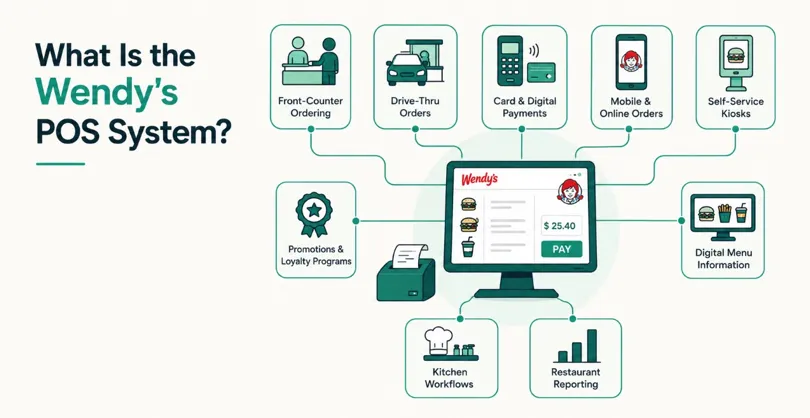
The Wendy’s Point of Sale System is the restaurant technology used to record orders and transactions at the point of purchase.
In a traditional restaurant, a POS may mainly replace the cash register. In a large quick-service operation, it needs to work within a much broader technology environment.
Depending on the restaurant and market, that environment may involve:
- Front-counter ordering
- Drive-thru orders
- Card and digital payments
- Mobile and online orders
- Self-service kiosks
- Digital menu information
- Kitchen workflows
- Promotions and loyalty programs
- Restaurant reporting
The important distinction is that these functions do not necessarily come from one piece of Wendy’s POS software.
Instead, the POS acts as one part of the restaurant’s overall ordering and operational technology.
What POS System Does Wendy’s Use?
This question has a more complicated answer than many online articles suggest.
Third-party industry sources have associated Wendy’s restaurants with NCR Aloha POS, and historical deployments have also involved different POS technologies and hardware suppliers. However, Wendy’s operates a heavily franchised global restaurant network, so it should not be assumed that every Wendy’s restaurant worldwide uses an identical software and hardware configuration.
What Wendy’s publicly documents more clearly today is its broader investment in restaurant technology.
The company is implementing technologies such as digital menu boards and Wendy’s FreshAI while continuing to invest in digital channels and restaurant operations. Its technology leadership covers areas including restaurant technology, data and analytics, software architecture, engineering, and information security.
That makes it more accurate to think of the Wendy’s POS as part of an evolving restaurant technology ecosystem rather than one universal terminal installed identically across every location.
How the Wendy’s POS System Works
The exact process depends on how the customer orders, but a typical transaction can be simplified into several stages.
1. The Customer Places an Order
An order can begin through channels such as:
- Restaurant counter
- Drive-thru
- Wendy’s mobile app
- Online ordering
- Self-service kiosk
- Supported delivery services
Each channel creates order information that ultimately needs to reach restaurant operations, making integrated quick-service POS software particularly important for high-volume restaurants.
2. The Order Is Captured
The Wendy’s ordering system records information such as selected products, sizes, quantities, customizations, promotions, and fulfillment method.
For a customized burger, for example, the system needs to communicate more than the name of the menu item. It must also preserve the changes the customer requested so the kitchen receives the correct instructions.
3. Payment Is Processed
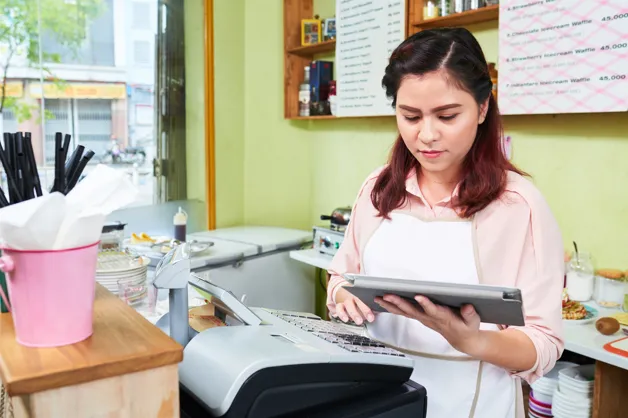
The Wendy’s payment system completes the financial side of the transaction using the payment options supported by that restaurant and ordering channel. This is where understanding the difference between a POS system and payment terminal becomes useful.
Once the transaction is approved, the order can continue through the fulfillment process.
4. The Order Moves to Restaurant Operations
The restaurant team needs clear information about what was ordered and how it should be prepared.
This connection between ordering and preparation is particularly important when several channels are generating orders simultaneously.
5. The Kitchen Prepares the Order
Kitchen teams prepare the products according to the incoming order information.
Modern restaurant technology helps organize this flow so employees can handle counter, drive-thru, mobile, kiosk, and delivery demand without treating every ordering channel as an entirely separate process.
6. The Order Is Fulfilled
The completed order reaches the customer through the appropriate channel, such as the counter, drive-thru window, mobile pickup area, or delivery service.
Major Technologies Connected to Wendy’s Ordering Experience
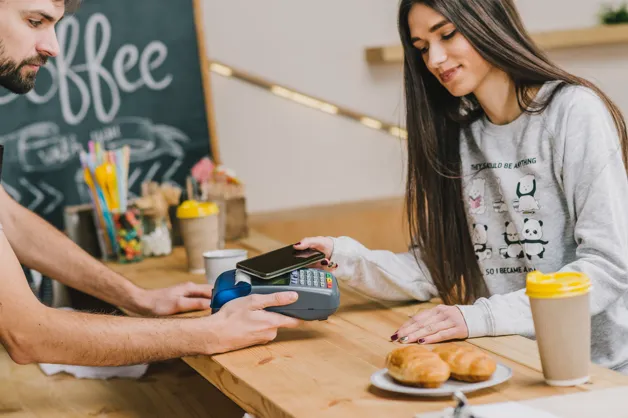
Understanding Wendy’s restaurant software requires looking beyond the POS terminal itself.
Several technologies now influence how customers place orders and how restaurants process them.
Wendy’s Digital Ordering System
Digital ordering has become increasingly important to Wendy’s.
In the first quarter of 2025, Wendy’s reported that its global digital sales mix reached a record 20.3%. That figure demonstrates why restaurant systems now need to accommodate orders that originate outside a traditional cashier interaction.
Customers can use digital channels to browse the menu, customize products, access offers, and place orders before interacting with the restaurant.
A modern Wendy’s food ordering system therefore needs to accommodate both physical and digital customer journeys, including POS integration with a website for restaurants that accept orders online.
Wendy’s Self-Service Kiosks
Self-service kiosks provide another way for customers to place their own orders.
Wendy’s Global Next Gen restaurant design includes self-order kiosks as part of its strategy for serving digital-first customers.
Instead of communicating each item to a cashier, customers can navigate a digital menu, choose products, select available customizations, and submit the order through the kiosk interface.
For restaurants, kiosks can also shift some ordering activity away from the traditional front counter.
Wendy’s FreshAI Drive-Thru Ordering
One of Wendy’s most notable technology projects is FreshAI, its AI-powered drive-thru ordering platform developed using Google Cloud technology.
FreshAI is designed to understand conversational orders, including the many ways customers may describe Wendy’s products and customizations.
The technology combines an AI-powered voice ordering experience with visual order information. Wendy’s has said the system is intended to improve speed, accuracy, and consistency while allowing restaurant employees to focus more attention on other tasks.
By May 2025, Wendy’s said FreshAI was processing tens of thousands of orders per day.
FreshAI shows how the ordering layer of a quick-service restaurant is evolving. The initial order may no longer need to be manually entered by an employee before it reaches restaurant operations.
Wendy’s Kitchen Management and High-Capacity Design
The ordering experience is only half of the challenge.
Restaurants also need enough kitchen capacity to fulfill the orders they receive.
Wendy’s has addressed this through its Global Next Gen restaurant design. The company says the format was designed to accommodate significantly more digital-order capacity than previous restaurant designs.
For restaurants facing especially high demand, Wendy’s also developed a Global Next Gen High-Capacity Kitchen.
According to Wendy’s, the high-capacity design was estimated to provide nearly a 50% increase in kitchen output capacity compared with the standard Global Next Gen format.
Features include:
- Dual-sided kitchen layouts
- Additional sandwich production areas
- Dedicated digital-order space
- More preparation space
- Expanded storage
- Self-order kiosks
- Mobile order pickup areas
- Delivery-focused pickup features
This highlights an important point about the Wendy’s kitchen management system: software alone cannot solve restaurant throughput problems.
The ordering technology, kitchen layout, equipment, employee workflow, and fulfillment process all need to support each other.
Wendy’s POS and Mobile Ordering
Mobile ordering creates a different workflow from a traditional counter transaction.
A customer can browse the Wendy’s menu, customize an order, use an eligible offer, submit the transaction digitally, and select an available pickup method.
The restaurant then needs to connect that digital transaction with its fulfillment workflow.
This reduces the need to recreate the same order manually at the counter.
Mobile ordering also creates opportunities for restaurant brands to connect ordering with rewards and personalized promotions.
For a large quick-service chain, that makes the digital ordering platform an increasingly important extension of the traditional POS experience, much like the shift from mobile POS to traditional POS as restaurants adopt more flexible ordering options.
Wendy’s POS vs. a Basic Restaurant POS
| Capability | Basic POS | Wendy’s-Style Restaurant Technology |
|---|---|---|
| Counter orders | Yes | Yes |
| Payment processing | Yes | Yes |
| Drive-thru ordering | Limited | Core channel |
| Mobile ordering | May require integration | Major digital channel |
| Self-service kiosks | Often optional | Used in modern restaurant designs |
| AI ordering | Rare | FreshAI drive-thru technology |
| Digital menu boards | Optional | Part of technology strategy |
| Kitchen integration | Basic or optional | Critical for high-volume operations |
| Digital order capacity | Varies | Built into the Next Gen restaurant strategy |
| Multi-location operation | Varies | Designed for a global restaurant network |
The key difference is scale and integration. A basic restaurant billing system may be sufficient for processing sales at one counter. Wendy’s needs technology that can support multiple customer channels while keeping restaurant operations organized, which is why the right POS system features matter beyond basic checkout.
Why Wendy’s Is Investing Heavily in Restaurant Technology
Fast-food customers increasingly expect more choice in how they order.
Some customers still prefer speaking with a cashier. Others use the drive-thru, mobile app, kiosk, online ordering, or delivery.
Wendy’s therefore has to build an experience that can support several ordering behaviors without making restaurant operations unnecessarily complicated.
The company’s technology strategy has focused on areas including:
- Improving order accuracy
- Increasing restaurant efficiency
- Expanding digital ordering
- Supporting higher-order volumes
- Simplifying restaurant workflows
- Improving customer convenience
- Creating more consistent ordering experiences
Wendy’s Project Fresh strategy, announced in 2025, also identified investments in hospitality, digital technology, equipment efficiency, simplified processes, labor, and technology as part of its operational improvement plans.
What Other Restaurants Can Learn From Wendy’s POS Strategy
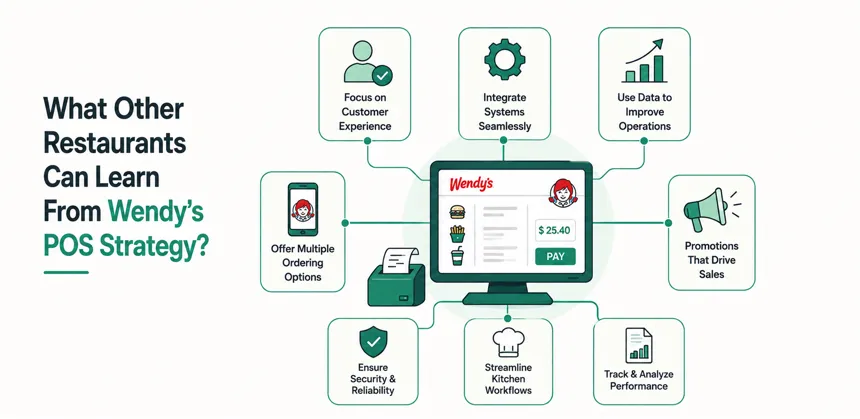
Small restaurants obviously do not need the same technology infrastructure as a global fast-food chain.
However, Wendy’s approach provides several useful lessons.
Connect Your Ordering Channels
Counter, website, kiosk, mobile, and delivery orders should ideally flow into a coordinated restaurant workflow.
Disconnected ordering channels can create unnecessary work and increase the chance of mistakes.
Make the Kitchen Part of the Technology Decision
Do not evaluate a POS solely by how quickly employees can enter an order.
Consider what happens after they press “send.”
Restaurant operators should examine whether the system can efficiently communicate orders to the kitchen and help employees prioritize multiple order channels.
Centralize Menu Information
Managing prices, products, modifiers, and promotions becomes harder when a restaurant sells through several channels.
Centralized menu management can reduce repetitive updates and inconsistencies.
Prepare for Digital Growth
Wendy’s reported that digital represented more than one-fifth of its global sales mix in Q1 2025.
Smaller restaurants may have very different numbers, but the broader lesson still applies: POS decisions should account for customers who prefer digital ordering.
Focus on the Entire Workflow
The best restaurant technology does more than process a payment. Evaluate how ordering, payments, kitchen communication, pickup, reporting, loyalty, and other important restaurant functions work together when deciding what to look for in a restaurant POS system.
Common Misconceptions About Wendy’s POS
A common misconception is that every Wendy’s restaurant worldwide necessarily uses exactly the same POS hardware and software.
Wendy’s operates thousands of restaurants across different franchisees and international markets. Technology configurations can therefore vary.
Another mistake is assuming the Wendy’s billing system and the company’s entire restaurant technology stack are the same thing.
The POS handles an important part of the transaction, but technologies such as mobile ordering, kiosks, FreshAI, digital menu boards, and kitchen-focused systems extend the ordering experience well beyond the traditional register.
FAQs About Wendy’s POS System
What POS system does Wendy’s use?
Third-party industry sources have associated Wendy’s with NCR Aloha POS, but Wendy’s does not publicly establish one identical POS configuration for every restaurant worldwide. Systems can vary by franchisee, market, and technology rollout.
What is Wendy’s POS software used for?
Wendy’s POS software supports restaurant order and transaction processing. Depending on the implementation, POS functionality can interact with other restaurant technologies used for digital orders, kitchen workflows, payments, reporting, and fulfillment.
Does Wendy’s use self-service kiosks?
Yes. Wendy’s Global Next Gen restaurant design incorporates self-order kiosks as one of the technologies designed to make ordering more convenient for digital-first customers.
Does Wendy’s use AI to take orders?
Yes. Wendy’s developed FreshAI with Google Cloud technology for drive-thru ordering. It uses generative AI to understand conversational customer orders and handle menu customizations.
Can a small restaurant use a POS system similar to Wendy’s?
A small restaurant does not need Wendy’s enterprise-scale infrastructure, but it can adopt the same principles. Look for a restaurant POS that can integrate ordering, payments, kitchen workflows, online ordering, reporting, and other channels your business actually uses.
Conclusion
The Wendy’s POS system is best understood as one component of a much larger restaurant technology environment.
Traditional point-of-sale functions remain essential for capturing orders and processing transactions, but Wendy’s is increasingly combining them with digital ordering, mobile experiences, self-service kiosks, digital menu boards, AI-powered drive-thru ordering, and restaurant designs built for greater digital demand.
The biggest lesson for other restaurant operators is integration.
Instead of choosing restaurant software based only on the checkout screen, consider the entire path an order follows — from the moment a customer chooses a meal to the moment the kitchen prepares it and the customer receives it.
If you’re evaluating a POS for your own restaurant, prioritize a system that can support today’s ordering channels while giving your business enough flexibility to handle tomorrow’s growth.